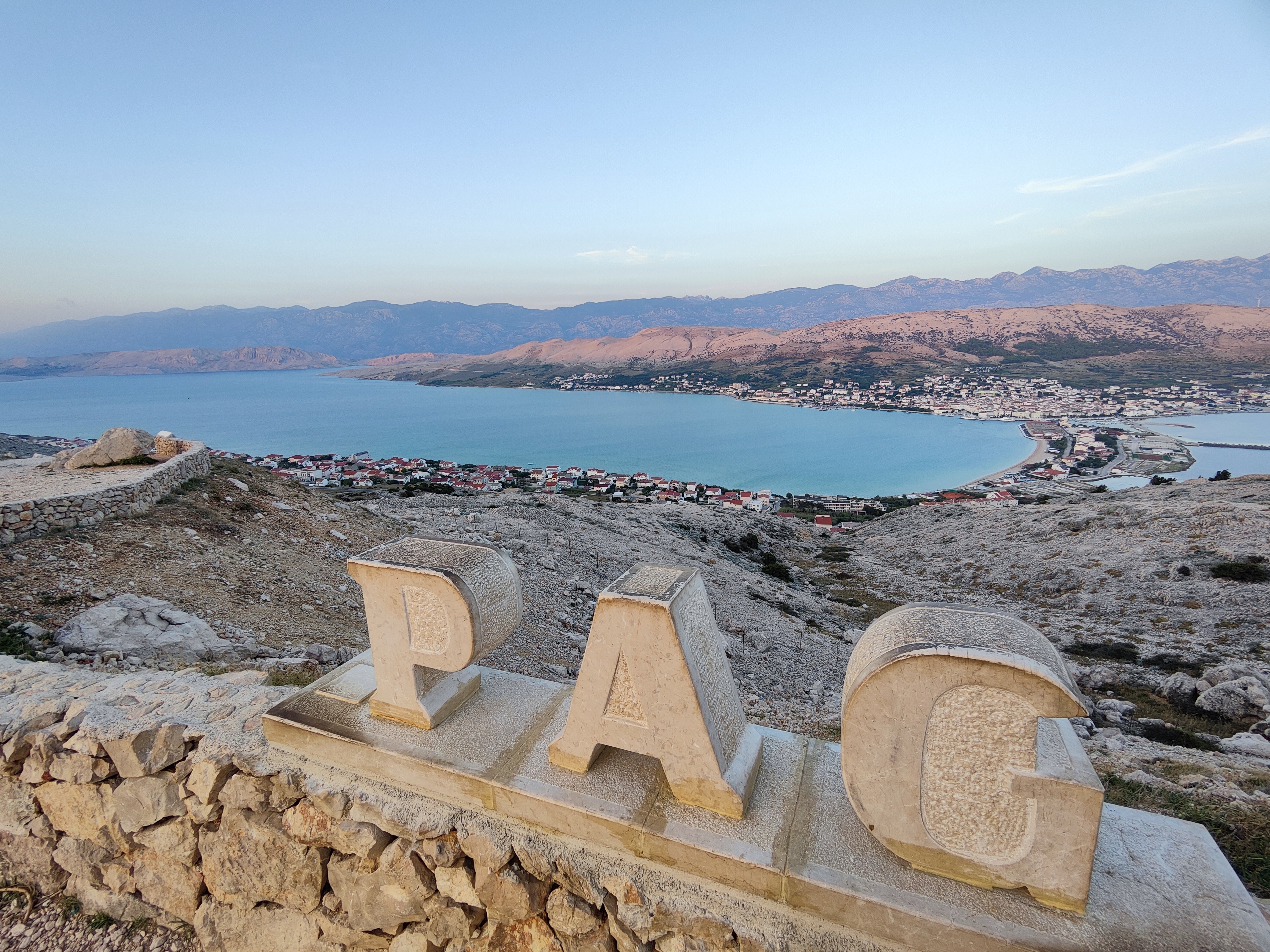
Pag is not what most travellers expect from Croatia. Where other Adriatic islands are green and pine-covered, Pag is bare, rocky and pale, stripped back by centuries of bura wind into something closer to a lunar landscape than a Mediterranean one. It is about 60 kilometres long and never more than about 10 wide, and you can drive onto it from the mainland without a ferry.
It is also the most misunderstood island in the country. Most people know one thing about Pag, and that thing is Zrće: four huge open-air clubs on a pebble bay, open more or less around the clock for about ten weeks a year. Zrće is real, but it occupies roughly one kilometre of a sixty-kilometre island. The rest is salt pans, sheep, a UNESCO-recognised lace tradition, olive trees that predate the Roman empire, and some of the emptiest coastline in Croatia.
This guide covers what to do on Pag, which beaches are worth the drive, whether to base yourself in Pag Town or Novalja, how to get here, and how to visit without spending heavily.
Is Pag Island Worth Visiting?
Yes, but more than most Croatian islands, it depends who you are. Pag does not do the one thing people picture when they imagine a Croatian island — soft green hills running down to a turquoise cove. If that is what you want, you will be happier on Korčula or Rab.
Pag is worth it if you fall into one of these groups:
- People who want the nightlife. Zrće is the biggest thing of its kind in Croatia and nothing else on the coast comes close.
- People who like food and craft traditions. Paški sir, Pag lace and hand-harvested salt give the island more to chew on than most.
- Hikers and photographers. The stone desert of the northern side is genuinely unlike anywhere else in the Adriatic.
- Families on a budget. Pag Town is calm, historic and considerably cheaper than the island’s party end.
- Anyone driving the coast. The bridge means you can add Pag to a road trip without a ferry booking.
Skip it if you need shade. Large parts of Pag have almost no trees, and in July and August that is not a small detail.
How Long Do You Need on Pag?
A day trip from Zadar or Nin realistically covers Pag Town, the salt pans and a swim. You will not get to Novalja and back comfortably as well.
Two to three days is the sweet spot. That gives you Pag Town, a cheese tasting, the drive north through the stone landscape, one of the quiet coves on the Metajna side, and Novalja or Zrće if you want them.
A week works if you are here for the beaches or the nightlife, or if you want to get up to Lun at the far northern tip, which is a long drive from anywhere.
Bear in mind that Pag is long. Pag Town to Novalja is around 30 kilometres and Novalja to Lun is another 25 or so, on roads that do not encourage speed. Distances here eat more time than the map suggests.
Best Things to Do on Pag Island
Explore Pag Town
Pag Town is the island’s historic centre and its most underrated attraction. It was laid out in the 15th century on a planned grid, which is unusual for Dalmatia, and the core is still intact.
- the Collegiate Church of the Assumption of Mary on the main square
- the Duke’s Palace (Kneževa palača), once the seat of the local governor
- the Skrivanat Tower, the last of nine towers that once ringed the walls
- stone streets, small squares and views across the bay to the salt pans
It costs nothing to walk, it takes about an hour, and it is where you will find the island’s lace shops and the better-value restaurants.
Taste Paški sir, the island’s cheese
Pag cheese is the island’s most famous export and the clearest example of how the landscape shapes everything here. The bura carries sea salt inland and deposits it on the low herbs the sheep graze on, and that works through into the milk. The result is a hard, sharp, slightly salty sheep’s cheese that most Croatians will tell you is the best in the country.
Several producers on the island run tastings and shop visits. Buying a wedge directly from a dairy or from a shop in Pag Town costs a fraction of what a restaurant charges for a cheese plate, and it travels well. Our guide to food in Croatia puts it in context with the country’s other regional specialities.
See Pag lace
Pag lace is made by hand with a needle, on a stiff base, in geometric patterns passed down through families. Croatian lacemaking, Pag’s tradition included, is recognised on UNESCO’s list of intangible cultural heritage.
You will see women making it in doorways around Pag Town in summer, and there is a lace gallery in the town. Real pieces are expensive because a small one takes many hours; anything cheap on a market stall is machine-made and imported. That is worth knowing before you buy.
Walk out to the salt pans
Salt has been produced at Pag for over a thousand years, and the pans stretching along the bay beside Pag Town are still working. They are the reason the town exists and the reason it was worth fortifying. Walking or cycling the flat road alongside them at the end of the day costs nothing and is the best light on the island.
Hike the stone desert
Pag’s northern side is where the lunar comparison comes from: bare karst, drystone walls running to the horizon, and almost no vegetation. It is a strange and rewarding place to walk.
- a roughly 10 km marked loop near Novalja, often called the Moon Trail, taking in Seline Bay
- Sveti Vid, the island’s highest point, with views across the channel to the Velebit range
- the Pag Triangle, a triangular rock formation reached by about a 45-minute walk on rough ground from Caska or Vidalići
There is no shade on any of these. Carry far more water than feels necessary and do not start them at midday in August.
Visit the Lun olive gardens
At the far northern tip of the island, past Novalja, a protected botanical reserve holds thousands of wild olive trees, the oldest of them reckoned to be around 2,000 years old. They are gnarled, low and enormous, and the reserve is the greenest thing on Pag by a wide margin.
It is roughly a 25-minute drive north of Novalja. There is an entrance fee to the reserve, and guided tours run in season. If you want the secluded beach inside the reserve, budget the entrance plus about a fifteen-minute walk down a gravel path.
Novalja and Zrće
Novalja is the island’s tourism hub: apartments, supermarkets, a promenade, boat trips and the bus connections. It is functional rather than beautiful, and it is where most of the island’s beds are.
Zrće sits in a bay a few kilometres outside it. Four large open-air clubs operate through the summer, alongside festivals, and an open minibus shuttles between Novalja centre, Gajac and the beach. The season is short — broadly mid-June to early September — and outside it the bay is quiet and the clubs are shut.
Best Beaches on Pag
Pag’s beaches are mostly pebble and rock rather than sand, and they range from the loudest bay in Croatia to coves where you will not see anyone all day.
Zrće
A pebble bay outside Novalja that has held Blue Flag status since 2003 and is, by daylight, a perfectly normal and rather good swimming beach with showers, toilets, watersports and a large car park. In the evening it becomes Croatia’s biggest club zone.
The beach itself is free to walk onto. The money goes on club entry, drinks, sunbeds and parking. Swimming here in the morning and leaving before the sound systems start is a legitimate and very cheap way to see it.
Prosika
The main beach at Pag Town, right beside the historic centre. Shallow, calm and easily the best option if you are travelling with children and staying in town — you can walk there from your accommodation rather than driving.

Ručica and Beritnica
Two coves on the Metajna side, and the images that sell Pag: pale, sculpted rock formations dropping into very clear water. Both need a walk or a rough drive down from the road, and neither has facilities. Take water, take shade, and wear something better than flip-flops on the descent.
The Novalja bays
Straško, Babe and the smaller coves around Novalja cover everything from a large developed campsite beach with charged access to unmarked stretches with nobody on them. Several of the quieter ones sit just outside town along the shoreline, and a few have natural shade, which is rarer here than it sounds.
The Lun coves
Between Jakišnica and Lun at the northern tip, small unspoiled coves face across the water towards Rab. Some are reached only by boat or by gravel track off the main road. This is where you go if the point of your holiday is not seeing other people.
If sand specifically is what you are after, Pag is the wrong island. Nin on the mainland nearby, Rab, and Sakarun on Dugi Otok are the real sandy options in this part of Croatia.
Pag Town or Novalja: Which Should You Base In?
This single decision shapes the whole trip more than anything else on Pag, and the two towns attract almost opposite crowds.
Pag Town is historic, quiet, walkable and cheaper. It has the old streets, the lace, the salt pans and a calm family beach. Nightlife is a handful of bars. It is around 30 kilometres from Zrće, so it is a poor base if partying is the plan.
Novalja has the apartments, the supermarkets, the bus links and the shuttle to Zrće. It is busier, younger and more expensive in peak season, and much of it is recent construction rather than old town.
A useful rule: if you are under 25 and here for the season, Novalja. Everyone else is usually happier in Pag Town, and can still drive up for a night out.
Pag on a Budget
Pag splits sharply into an expensive version and a cheap one, and which you get depends almost entirely on decisions you make before arriving.
Free on Pag:
- walking Pag Town’s historic centre and its surviving tower and walls
- the salt pans road at sunset
- hiking the Moon Trail, Sveti Vid and the Pag Triangle
- almost every beach, Zrće included — including Ručica, Beritnica and the Lun coves
- watching lace being made in Pag Town doorways in summer
Cross the bridge, don’t take the ferry. Coming from Zadar or anywhere south, the Pag bridge is free and puts you on the island without a ticket. The Prizna–Žigljen ferry is only the cheaper option if you are coming from the north, where it saves a very long drive around the top of the Velebit range.
Stay in Pag Town, not Novalja, if you have any flexibility. The price gap in July and August is substantial, and the bus between them is cheap. Camping is cheaper still — the big campsite outside Novalja is one of the best-known in Croatia — and private apartments in the smaller villages undercut both towns.
Buy food in the supermarket. Novalja and Pag Town both have proper supermarkets. Beach bars and the club food courts at Zrće charge several times what the same thing costs in town, and Pag is an easy island to picnic on — buy cheese, bread and tomatoes and eat on a cove.
Buy the cheese at source. A wedge of Paški sir from a dairy shop is a fraction of the price of a restaurant cheese board, and it is the single best-value souvenir on the island.
Come in June or September. Accommodation drops sharply either side of the July–August peak, the sea is still warm in September, and the hiking becomes possible again. The trade-off is that the Zrće clubs only run for a short window in high summer, so the cheapest months are also the quietest ones.
Where the money actually goes on Pag is club entry, drinks at Zrće, sunbed hire and parking. None of those are unavoidable. Our Croatia cost guide has realistic daily budgets for the rest of the country.
How to Get to Pag Island
Pag is one of the easiest Croatian islands to reach, because you do not strictly need a boat at all.
By bridge, from Zadar and the south
The Paški most is a short bridge joining the island’s southern end to the mainland near Posedarje. From Zadar, take the A1 to the Posedarje exit and follow signs for Pag. Reckon on roughly an hour to Pag Town and about an hour and a half to Novalja. There is no toll on the bridge itself.
By ferry, from the north
Jadrolinija’s line 335 crosses from Prizna, on the coast road below the Velebit mountains near Senj, to Žigljen at the island’s northern tip. The crossing takes about 15 minutes and runs roughly hourly, far more often in peak summer.
Published fares put a foot passenger at around €4 in high season and a car with driver at roughly €18, with lower rates outside the season. Check Jadrolinija directly for current prices and sailings rather than a third-party planner. If you are driving down from Rijeka or Istria, this crossing saves a substantial detour and lands you close to Novalja.
By bus
Buses run to Pag from Zadar, Rijeka, Zagreb and Split, most terminating at Novalja. From Zadar, allow around an hour to Pag Town and roughly an hour and a half to Novalja. This is the cheapest way onto the island without a car, and island buses then connect Pag Town and Novalja.
Getting around once you’re there
A car makes Pag much easier, because the island is long and the good coves are down unmarked tracks. Without one, you can still manage: island buses link the two towns, and an open minibus shuttles between Novalja, Gajac and Zrće through the season. Taxis exist but agree the fare before you get in, and expect an evening surcharge.
Where to Stay on Pag Island
Pag Town. Historic, calm, walkable, cheaper. Best for families, couples and anyone who wants the island rather than the nightlife.
Novalja and Gajac. The bulk of the island’s apartments, the supermarkets and the Zrće shuttle. Peak-season prices reflect the demand.
Campsites. The large campsite on the shore outside Novalja is among the best known in Croatia and by far the cheapest way to sleep near Zrće.
Metajna, Šimuni, Povljana and the smaller villages. Quieter, more local, better value, and closer to the coves. You will want a car.
Lun and Jakišnica. The far north, near the olive gardens. Remote in a way that is either the point or a problem.
Best Time to Visit Pag
May and June. The landscape is at its best before the summer bleaches it, hiking is comfortable, prices are low and the sea is swimmable from late May. The clubs are mostly not open yet.
July and August. Peak everything — the festivals, the clubs, the crowds and the prices. Also the hottest and most exposed time to be on an island with almost no shade.
September. The best month for most travellers. Warm sea, thinning crowds, falling prices, and the light on the stone is extraordinary.
Winter. Dramatic and almost empty, but the bura on Pag is serious — strong enough to close the bridge and the ferry on the worst days. Much of the tourist infrastructure shuts.
Common Mistakes Visitors Make on Pag
- Booking Novalja and expecting the old town. The historic streets are in Pag Town, 30 km away.
- Booking Pag Town and expecting the nightlife. The same 30 km applies in reverse.
- Underestimating the distances. The island is 60 km long on slow roads. Lun is a serious drive from Pag Town.
- Arriving without shade or water. Pag has very little natural cover and it catches people out every summer.
- Taking the ferry from the south. The bridge is free and closer if you are coming from Zadar.
- Buying cheap lace as a souvenir. Genuine Pag lace takes many hours to make and is priced accordingly.
- Coming for Zrće outside the short season. Turn up in late May or October and the bay is empty and the clubs are closed.
Pag vs Nin
They sit close together at the top of northern Dalmatia and they are near-opposites, which makes them a good pairing rather than a choice.
Nin is flat, sandy, shallow and quiet — the best family beach destination on this stretch of mainland, with a medieval old town on an islet and Croatia’s longest sandy beach. Pag is rocky, dramatic, much larger, and has the nightlife and the food traditions Nin lacks.
Nin sits on the road north towards the Pag bridge, so combining them on a road trip costs almost no extra driving.
Pag vs Other Croatian Islands
- vs Hvar: Hvar’s nightlife is polished, expensive and in a beautiful old town. Pag’s is louder, younger, cheaper and in a field by the sea.
- vs Rab: Rab is green, sandy and family-oriented — visible from Pag’s northern tip and almost its inverse.
- vs Vis: Vis is remote, slow and hard to reach. Pag is the easiest island in Croatia to drive onto.
- vs Korčula: Korčula has the better old town and the wine. Pag has the stranger landscape and the cheese.
- vs Krk: the other bridge-connected island. Krk is greener, busier and closer to Rijeka.
Pag’s case is variety and strangeness rather than conventional beauty. Nowhere else in Croatia gives you a UNESCO craft tradition, a thousand-year-old saltworks, a stone desert and a superclub within an hour’s drive.
Day Trips from Pag
Zadar is about an hour from Pag Town over the bridge, and is the obvious mainland trip: the Roman forum, the Sea Organ and a proper old city.
Nin is on the same road and adds sandy beaches and a 9th-century church to the drive.
Rab is reachable by seasonal passenger boat from Novalja and is the greener, sandier counterpoint to Pag.
The Velebit coast road below Prizna, towards Senj, is one of the more dramatic drives in the country if you are heading north anyway.
Pag Island FAQs
Is Pag Island worth visiting?
Yes, if you want something different from a typical Croatian island. Pag offers a stark, almost lunar landscape, a UNESCO-recognised lace tradition, Croatia’s best-known sheep’s cheese, a thousand-year-old saltworks and the country’s biggest nightlife scene at Zrće. It is a poor choice if you want green scenery, sandy beaches or shade.
What is Pag Island known for?
Pag lace, Paški sir cheese made from sheep grazing on salt-dusted herbs, hand-harvested sea salt produced here for over a thousand years, its bare rocky landscape, and Zrće Beach — Croatia’s biggest open-air club zone.
Is Pag just a party island?
No. The clubs occupy roughly one kilometre of a sixty-kilometre island and run for about ten weeks a year. Pag Town at the southern end is historic, quiet and family-friendly, and the northern half is largely empty coastline, hiking country and olive groves.
Should you stay in Pag Town or Novalja?
Pag Town is historic, calmer and cheaper, and suits families, couples and anyone here for the island itself. Novalja has most of the apartments, the supermarkets and the shuttle to Zrće, and suits younger travellers here for the nightlife. They are about 30 kilometres apart, so choose deliberately.
How do you get to Pag Island?
From Zadar and the south, drive across the Pag bridge — no ferry and no toll, roughly an hour to Pag Town. From the north, Jadrolinija’s line 335 car ferry crosses Prizna to Žigljen in about 15 minutes. Buses also run from Zadar, Rijeka, Zagreb and Split, mostly to Novalja.
Is Zrće Beach free?
The beach itself is free to walk onto and is a normal Blue Flag swimming beach during the day, with showers, toilets and watersports. You pay for club entry, drinks, sunbed hire and parking. Swimming there in the morning and leaving before the clubs open costs very little.
What are the best beaches on Pag?
Zrće for the scene and the swimming, Prosika at Pag Town for families, and Ručica and Beritnica on the Metajna side for the dramatic rock formations. The coves between Jakišnica and Lun are the quietest. Pag’s beaches are mostly pebble and rock rather than sand.
How many days do you need on Pag?
Two to three days covers Pag Town, a cheese tasting, the drive north through the stone landscape and a quiet cove or two. A day trip from Zadar realistically gets you Pag Town and a swim. A week makes sense if you are here for the beaches or the nightlife.
When is the best time to visit Pag?
September is the best month for most travellers — warm sea, thinner crowds and lower prices. May and June are best for hiking and the landscape. July and August bring the festivals and the clubs along with the highest prices and no shade.
Pag is usually written off as either a party island or a pile of rocks, and it is neither. Few places in Croatia stack a UNESCO craft tradition, a working saltworks, 2,000-year-old olive trees, a stone desert and a superclub into the same sixty kilometres. That range is the reason to come, and it is why the island rewards a couple of days rather than an afternoon.
Explore more of Croatia’s islands and coastline in our complete Croatia travel guide.
Leave a Reply