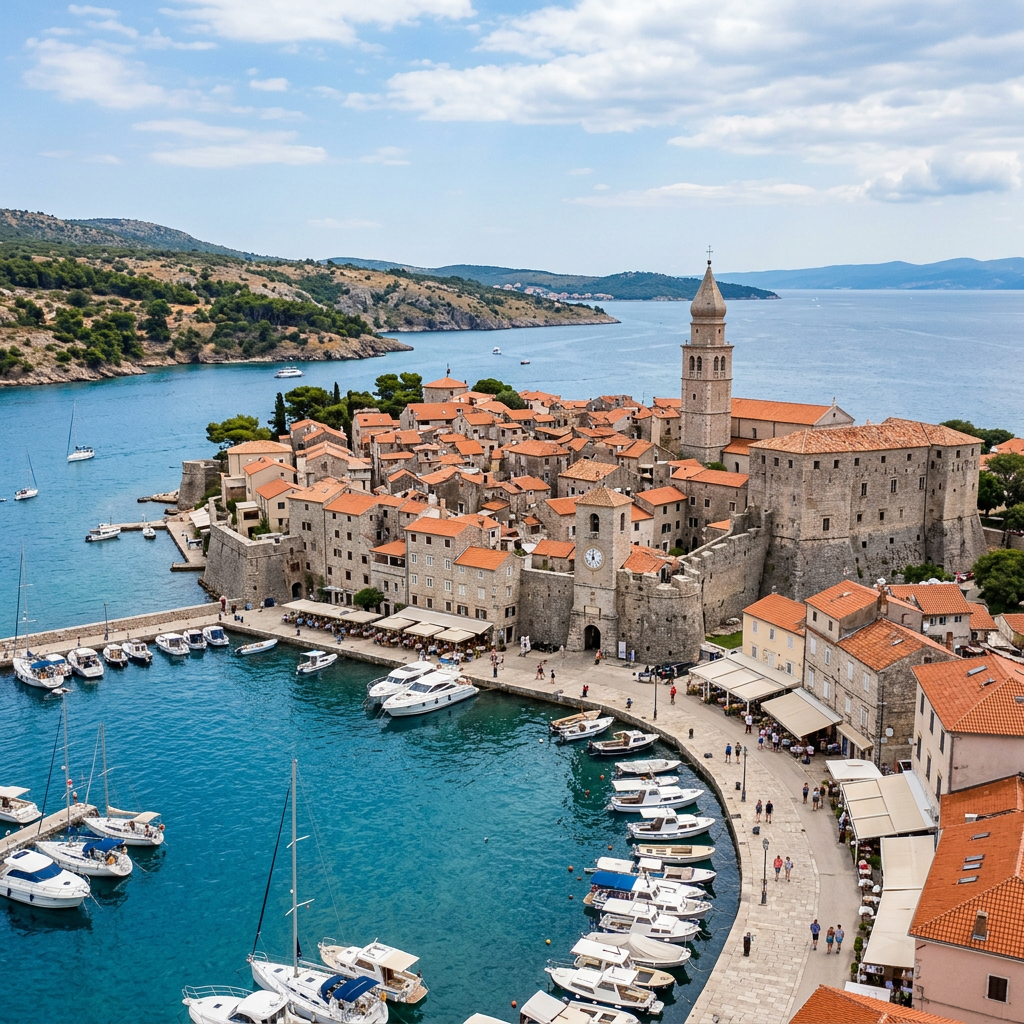
Krk is the Croatian island you can drive to. A 1.4-kilometre bridge has joined it to the mainland since 1980, the bridge is toll-free, and Rijeka Airport is on the island itself rather than near it. No ferry, no timetable, no queue.
That accessibility is the whole proposition, and it cuts both ways: Krk is the easiest island in Croatia to reach and consequently the busiest in August. It is also the largest by area, effectively tied with Cres, so there is more room to escape into than the crowds at Baška suggest.
This guide covers what to actually do here, which beaches are worth the drive, where the island is cheap and where it is not, and whether Krk or one of its neighbours is the better choice.
Is Krk Worth Visiting?
Yes, and it is the right first Croatian island for most people. It asks nothing of you logistically, it has genuine variety, and it is one of the sunniest places in Europe at roughly 2,500 hours a year.
It suits you if:
- you are driving from Zagreb, Slovenia, Austria or Italy and do not want a ferry
- you want a long, serviced beach that works with children
- you want restaurants, shops and towns rather than emptiness
- you are using it as a base to reach Cres, Rab and the rest of Kvarner
- you are flying in, since the airport is on the island
It suits you less if you want the island to feel remote. Krk is the most developed island in Kvarner: the north end near the bridge and the airport is industrial in places, the resorts along the west coast are large, and Baška in August is very busy. If emptiness is the point, Cres is a short ferry away and the opposite experience.
How Long Do You Need on Krk?
One day
Krk Town and one other place — realistically Vrbnik or Punat. It works as a day trip from Rijeka, and unlike most Croatian islands it genuinely does, because there is no crossing to plan around.
Three to four days
The sensible amount. Krk Town, Vrbnik for the wine and the alley, a full day at Baška, and Košljun by boat from Punat.
A week
Works if you are using Krk as a Kvarner base. The Valbiska ferries put Cres and Rab within a day trip each, and the island has enough beaches and walking trails to fill the days in between.
Best Things to Do on Krk
Krk Town
The island’s main town, walled, with a Romanesque cathedral, a Frankopan castle on the harbour front and a compact grid of stone lanes built over the Roman street plan. It has most of the island’s restaurants and shops, and the old town is small enough to walk in half an hour.
Walking it is free. The castle and cathedral charge modest entry.

Vrbnik and the Klančić alley
A village on a limestone cliff about 50 metres above the sea on the east coast, and the most photogenic place on Krk. It is the home of Žlahtina, the island’s native white wine, grown on the plain behind the village and poured in family konobas along the lanes.
Vrbnik’s other claim is Klančić, widely described as the narrowest street in the world at around 43 centimetres at its tightest. Adults have to turn sideways, and a fair number cannot get through at all. It is free, it takes two minutes, and it is the thing everyone remembers.
Park at the top and walk down. The village lanes are not driveable.
Baška and the Baška Tablet
Baška sits at the southern end of the island beneath bare hills, and it has the beach most people come to Krk for. It also sits beside one of the most important objects in Croatian history.
In the village of Jurandvor, just inland, the small Church of St Lucy is where the Baška Tablet was found — a stone slab carved around the year 1100 in Glagolitic script, recording a grant of land by King Zvonimir. It is the oldest substantial text in the Croatian language, and it is why this corner of a small island matters far beyond it.
Worth knowing before you go: the original is in Zagreb, held by the Croatian Academy of Sciences and Arts. What stands in the church at Jurandvor is a replica. That does not make the visit pointless — the church is where it was found and where it sat for centuries — but plenty of guides imply you are seeing the original, and you are not.
Košljun island
A wooded islet roughly 300 metres across in the bay off Punat, holding a Franciscan monastery with an ethnographic museum and a library of tens of thousands of books. Taxi boats run across from Punat harbour continuously in season and the crossing takes minutes.
It is the best half-day on the island that does not involve a beach, and it is quiet even in August because most visitors never leave the coast road.
Biserujka Cave
A small lit karst cave near Rudine in the north of the island, with stalactites and a short guided route. Modest and inexpensive, and a genuinely useful option on a wet day or in peak heat, when it is the coolest place on Krk.
Walk the Baška valley trails
The hills behind Baška are bare, steep and criss-crossed with marked trails, including the route down from the Treskavac pass into the valley and out to the harbour. The landscape up there is closer to Pag than to the green west coast, and the views over the Kvarner are the best on the island.
Free, and best in spring or autumn — there is no shade at all.
Best Beaches on Krk
Vela plaža, Baška
The island’s headline beach and one of the longest in the Adriatic at around 1,800 metres. Pebble underfoot with a sandy seabed further out, backed by the whole length of Baška’s promenade, with full facilities, loungers, bars and watersports.
It is free to walk onto; you pay for parking and for anything you hire. It is also extremely popular across central Europe and fills early in July and August — go first thing, or walk the coastal path out to the smaller coves east of the town, which stay far quieter.
Stara Baška
A separate village on the other side of the southern headland, reached by a narrow road, with a string of small pebble coves and almost no development. The best swimming on Krk if you want clear water without a resort behind you. Facilities are minimal, so bring what you need.
Punat and the bay
The sheltered Puntarska Draga bay is calm and shallow, which makes it the easiest water on the island for small children, with beaches either side of the marina. Not dramatic, but practical.
Malinska and the north-west coast
The greenest stretch of the island, with a long shoreline path linking a series of small pebble and concrete bays between Malinska, Njivice and Porat. Pine shade in places, plenty of facilities, and easy to reach on foot from most of the accommodation along that coast.
Every beach on Krk is free to enter. The costs are parking and hire.
Krk on a Budget
Krk’s budget advantage is structural: no ferry. On every other Croatian island you pay to get a car across and pay again to leave. Here you drive over a free bridge, which removes the single largest fixed cost of an island holiday.
Free on Krk:
- the bridge crossing
- every beach, Vela plaža included
- walking Krk Town, Vrbnik, Baška and Punat
- the Klančić alley
- the marked trails in the Baška valley and the coastal paths
Camp, or stay inland. Krk has one of the densest campsite networks in Croatia, several of them directly behind beaches at Baška, Punat and Njivice. Apartments in the inland villages — Dobrinj, Vrh, Risika — cost noticeably less than the coastal resorts and are ten minutes from the water by car.
Avoid the July and August resort strip. The west coast between Omišalj and Malinska is package-holiday territory and priced accordingly. Baška old town and the inland villages are better value for the same island.
Buy Žlahtina in Vrbnik, not on a terrace. The producers sell at the source for a fraction of restaurant prices, and several will fill a container for you.
Use Krk as the cheap gateway to Kvarner. From Valbiska you can day-trip to Cres or Rab and come back, without paying island accommodation prices on either. Our Croatia cost guide has the wider daily numbers.
Come in June or September. Krk’s season is long and its shoulder months are warm. Prices drop sharply, Vela plaža stops being a scramble for space, and the walking becomes possible again.
How to Get to Krk
By car, over the bridge
The Krk bridge leaves the mainland south-east of Rijeka and lands at the northern tip of the island. Roughly 45 minutes from Rijeka and about two and a half hours from Zagreb.
The bridge is toll-free. Older guidebooks and forum posts still mention a charge, which was dropped — do not budget for it.
By air
Rijeka Airport is at Omišalj, on Krk itself, not on the mainland. This catches people out in both directions: if you are flying here your transfer is minutes rather than an hour, and if you are flying to Rijeka city you still have a bridge to cross.
By bus
Buses run to Krk Town from Rijeka and Zagreb, crossing the bridge, with onward island services to Baška, Punat, Malinska and Vrbnik. Frequency is decent in summer and drops off out of season, so check current times before relying on them.
Ferries onward from Valbiska
Valbiska on the west coast is the departure port for two Jadrolinija crossings: to Merag on Cres, about 20 to 25 minutes, and to Lopar on Rab, around 80 minutes. This is what makes Krk a practical base for the whole of Kvarner.
Getting Around Krk
Krk is large — over 400 square kilometres — and its towns are spread around the coast rather than clustered. Baška to the bridge is the better part of an hour.
Island buses link the main settlements and are usable, which is unusual for a Croatian island, so Krk is one of the few you can do without a car if you base yourself in Krk Town or Baška. A car still makes Stara Baška, Vrbnik and the northern villages far easier.
Parking is charged in season in Krk Town, Baška, Punat and Vrbnik, and the beach car parks at Baška fill by mid-morning in August.
Where to Stay on Krk
Krk Town
Most central, best for restaurants and bus connections, and the easiest base without a car. Good compromise if you want to see the whole island.
Baška
Best if the beach is the holiday. A long promenade, plenty of apartments and campsites, and the hiking trails on the doorstep. Furthest from the bridge, and busiest in peak season.
Punat and Malinska
Punat for the sheltered shallow bay and Košljun, and it works well with small children. Malinska for the greener north-west coast and its shoreline path, though this is the most resort-like part of the island.
Vrbnik and the inland villages
Quietest and generally cheapest, with the best views. You will drive for the beach, and that is the trade.
Travelling with children? See our guide to family travel in Croatia.
Best Time to Visit Krk
May and June. Green, comfortable for walking the Baška hills, prices low and the beaches empty. Sea swimmable from late May.
July and August. Warmest sea, everything open, and by far the busiest. This is when Vela plaža fills before ten and the bridge backs up on changeover weekends.
September. The best month for most people — warm sea, thinning crowds, falling prices, and the walking trails usable again.
Winter. Quiet, with much of the coastal accommodation closed, though Krk Town stays open and functioning in a way most island towns do not. The bura can blow hard across the bridge, and it is occasionally closed to high-sided vehicles.
What to Eat and Drink on Krk
Two things are specifically Krk’s. Žlahtina, the dry white grown around Vrbnik and made almost nowhere else, and šurlice, hand-rolled pasta tubes traditionally served with goulash or seafood — the island’s own dish and the one to order.
Beyond that: Krk lamb from sheep grazing the bare southern hills, sheep’s cheese, olive oil, and prosciutto. Our guide to food in Croatia covers the regional differences.
Common Mistakes Visitors Make on Krk
- Budgeting for a bridge toll. There isn’t one, despite what older guides say.
- Booking near the bridge to be close to the airport. The airport is already on the island; the northern tip is the least attractive part of it.
- Arriving at Vela plaža at eleven in August. It fills early, and so does the parking.
- Expecting to see the original Baška Tablet at Jurandvor. It is in Zagreb; the church holds a replica.
- Trying to drive into Vrbnik. Park above the village and walk down.
- Underestimating the island’s size. Baška to the bridge is close to an hour, and Krk is not a place you see in an afternoon.
- Missing Stara Baška because the road looks bad. It is the best swimming on the island.
Krk vs Cres, Rab and Pag
All four are in or beside the Kvarner and easy to combine.
- vs Cres: Cres is emptier, wilder and better for hiking and wildlife; Krk has the infrastructure, the restaurants and the easy access. Krk first, Cres if you want to escape it.
- vs Rab: Rab has the sand and the better old town; Krk has the bridge and the size. With small children who want sand rather than pebble, Rab wins.
- vs Pag: Pag is starker, has the cheese and lace and Zrće; Krk is greener and far more varied. Both are bridge-connected, so neither needs a ferry.
- vs Mali Lošinj: Lošinj is greener still and built around wellness and dolphins; Krk is bigger and more practical as a base.
Heading down the coast instead? Senj is the gateway to the Velebit coast and the Prizna ferry to Pag.
Krk Island FAQs
Is Krk worth visiting?
Yes, and it is the easiest Croatian island to reach — a toll-free bridge from the mainland and an airport on the island itself. It has a walled old town, the cliff village of Vrbnik, one of the Adriatic’s longest beaches at Baška, and enough size to escape the crowds. It is also the most developed island in Kvarner, so it is not the one to pick if you want remoteness.
How do you get to Krk?
By car over the 1.4 km Krk bridge from the mainland south-east of Rijeka — about 45 minutes from Rijeka and two and a half hours from Zagreb. The bridge is toll-free. Rijeka Airport is on Krk itself at Omišalj, and buses run to the island from Rijeka and Zagreb.
Is there a toll on the Krk bridge?
No. The Krk bridge is toll-free. Older guidebooks and forum posts still refer to a charge, but it no longer applies, so there is nothing to budget for in either direction.
What is the best beach on Krk?
Vela plaža at Baška is the headline beach — around 1,800 metres of pebble with a sandy seabed and full facilities, and free to enter. It fills early in July and August. Stara Baška has the clearest water and the fewest people, and the Malinska to Njivice shoreline path links a string of smaller bays with pine shade.
How many days do you need on Krk?
Three to four days covers Krk Town, Vrbnik, a full day at Baška and the boat to Košljun. One day works as a trip from Rijeka since there is no ferry to plan around. A week makes sense if you are using Krk as a base for day trips to Cres and Rab.
Can you visit Krk without a car?
Yes, more easily than most Croatian islands. Island buses link Krk Town, Baška, Punat, Malinska and Vrbnik, and are usable if you base yourself in Krk Town or Baška. A car still makes Stara Baška, the northern villages and the inland trails far easier to reach.
What is Krk known for?
Being the only large Croatian island reachable by road; the Baška Tablet, the oldest substantial text in Croatian, found at Jurandvor near Baška; Žlahtina wine from Vrbnik; the Klančić alley, widely called the narrowest street in the world at about 43 centimetres; and the monastery islet of Košljun.
Is Krk expensive?
It is mid-range, and cheaper than it looks because there is no ferry cost to get a car onto the island. Every beach is free, the towns cost nothing to walk, and the campsite network is dense. The resort strip on the west coast is the priciest part; inland villages and Baška old town are better value.
When is the best time to visit Krk?
May, June and September. Warm enough to swim, much cheaper, and the Baška hill trails are comfortable rather than punishing. July and August bring the warmest sea along with full beaches, charged parking that fills by mid-morning, and queues on the bridge at weekends.
Krk is the island to pick when you do not want the island to be the difficult part. You drive over a free bridge, the airport is already there, the buses work, and everything from a 1,800-metre beach to a 43-centimetre alley is within an hour of wherever you are staying.
Stay inland or in Baška old town rather than on the resort strip, and use Valbiska to see Cres and Rab while you are here. More of Kvarner and the rest of the country in our complete Croatia travel guide.
Leave a Reply