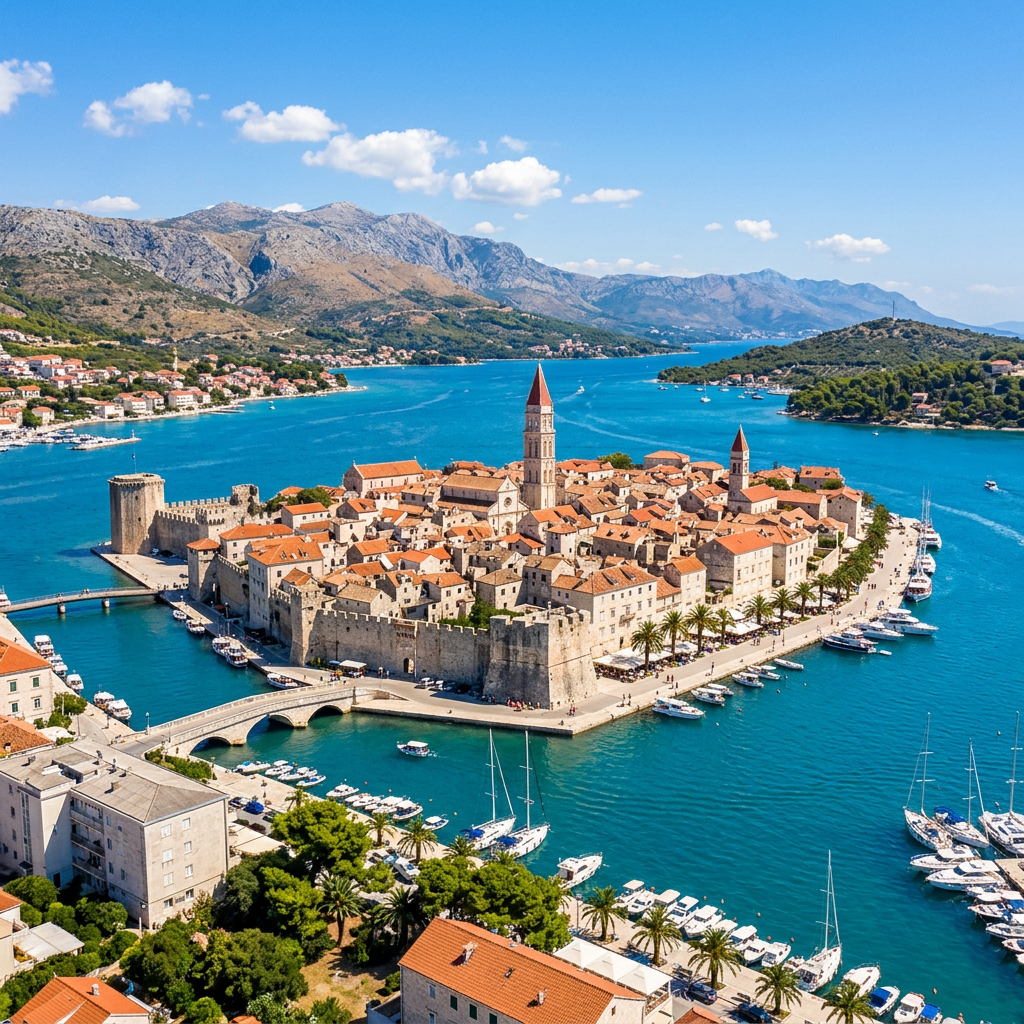
Trogir is a walled medieval town on a small island, wedged between the mainland and the island of Čiovo and joined to both by short bridges. The old town is UNESCO-listed, it is about 500 metres end to end, and you can walk the whole thing in half an hour.
Its most useful feature is one almost no guide states plainly: Split Airport is five to six kilometres away. Trogir is closer to the airport than Split is, which makes it the obvious first or last night of a Dalmatian trip and a genuinely cheaper base than the city.
This guide covers what to see in the old town, which Čiovo beaches are worth the bus, where to park, and whether to base yourself here or in Split.
Is Trogir Worth Visiting?
Yes. Trogir has one of the most complete Romanesque-Gothic town plans in central Europe, which is why UNESCO listed it in 1997, and unlike Dubrovnik it has not been emptied of residents.
It suits you if:
- you are flying into or out of Split Airport and want somewhere real to stay
- you want a UNESCO old town without Dubrovnik’s crowds or prices
- you want history and a beach within twenty minutes of each other
- you are basing yourself in central Dalmatia and want to spend less than Split
- you do not want to drive, since the buses here are unusually good
The honest caveat: Trogir is small, and in July and August the old town takes serious coach and cruise traffic in the middle of the day. It also sits close to the Split Airport approach, so there is aircraft noise. Stay one night and you will barely notice it; stay a week in August and you might.
How Long Do You Need in Trogir?
Half a day
Enough for the old town, the cathedral, the bell tower and Kamerlengo. That is the standard day trip from Split and it genuinely covers the town.
One or two nights
The sweet spot, and what the airport proximity is for. Old town in the evening once the coaches have gone, a Čiovo beach the next morning, out to the airport in fifteen minutes.
A week as a base
Works well. Split, Klis, Šibenik, Krka and the islands are all day trips, and you sleep somewhere cheaper and quieter than the city with a beach on the far side of a bridge.
Best Things to Do in Trogir
Walk the old town
The island old town still follows its ancient street grid, overlaid with Romanesque, Gothic, Renaissance and Baroque building. It is dense, shaded and almost entirely traffic-free, and the whole of it takes half an hour to cross.
Enter through the North Gate, work down to the main square, then out to the Riva. Walking it costs nothing, and the best time is early morning or after six, when the day-trippers have gone and the town belongs to the people who live in it.

The Cathedral of St Lawrence and Radovan’s Portal
The cathedral dominates the main square, and the reason to stop is the west door. Radovan’s Portal, carved in 1240 by the master mason Radovan, is the finest piece of Romanesque sculpture in Croatia — a dense stone frame of apostles, saints, the months of the year, hunting scenes and two lions, with Adam and Eve standing on their backs.
You can look at the portal from the square for nothing. Entry to the cathedral interior and the treasury is charged.
Climb the bell tower
The cathedral’s bell tower took three centuries to finish, and each stage is in a different style. The climb is up narrow stone stairs that open out near the top with little by way of modern railing — worth knowing if you are uneasy with heights or carrying small children.
The view over the terracotta roofs, the channel and Čiovo is the best in town and the reason most people climb it.
Kamerlengo Fortress
The Venetian fortress at the western tip of the island, built in the 15th century to watch the channel. Inside it is essentially an empty shell, so go for the walls: you can walk them and look back over the whole town, the marina and the water.
Modest entry fee. It doubles as an open-air venue for concerts and film screenings in summer, which is the best way to see it.
Cipiko Palace and the town loggia
Facing the cathedral across the square are the Cipiko palaces, with their Venetian Gothic windows, and the open town loggia where justice was administered — its stone table and clock are still there. Both are free to stand and look at, and together with the cathedral they make one of the most complete medieval civic squares on the Adriatic.
The Riva and the green market
The southern waterfront runs the length of the island facing Čiovo, lined with palms, cafés and moored boats — this is where Trogir does its evening walk. Just over the bridge on the mainland side is the green market and fish market, which is where to buy food rather than eat it.
Best Beaches near Trogir
There is no beach in the old town itself. They are all on Čiovo across the bridge, or west along the mainland coast, and the local buses go to both.
Okrug Gornji, also called Copacabana
The main beach, roughly two kilometres of pebble on the south side of Čiovo, about fifteen minutes from Trogir by bus. Okrug Gornji and “Copacabana” are the same beach — the nickname belongs to the busy bar-lined central stretch, and plenty of listings present them as two separate places.
It has everything: bars, loungers, watersports, showers. It is also loud and packed in August. Walk a few minutes along the shore from the central section and it thins out considerably.
Slatine and eastern Čiovo
The far end of the island, quieter and much less developed, with small pebble coves and clear water. Reachable by bus or, in season, by boat directly from Trogir. This is where to go if Okrug sounds like a nightmare.
Medena and the mainland coast
West of Trogir towards Seget, a long stretch of pebble and concrete backed by hotels and pine, with easy access and facilities. The practical family option, and walkable from the town along the water.
The Blue Lagoon
A shallow, very clear bay near the islet of Drvenik Veli, reachable only by boat and sold from the Trogir waterfront as a half or full-day trip. It is genuinely beautiful and genuinely crowded with boats in peak season, so take an early departure if you go.
All the beaches are free. You pay for loungers, boats and parking.
Trogir on a Budget
Trogir’s budget case is the airport. A night here instead of in Split saves you on the room and removes the transfer almost entirely, and bus 37 connects the two for the price of a local ticket.
Free in Trogir:
- the whole old town, its squares and the North Gate
- Radovan’s Portal, viewed from the square
- the loggia and the Cipiko palace exteriors
- the Riva, the marina and the walk around the island
- every beach on Čiovo and along the mainland coast
Skip the airport transfer. Private transfers from Split Airport are priced for people going to Split. You are five kilometres away — a taxi is short, and bus 37 stops at the airport and runs into Trogir for a couple of euros.
Use bus 37 instead of an excursion. The Split–Airport–Trogir service runs from around four in the morning until after midnight. Day trips to Trogir sold in Split cost many times the fare for the same journey.
Stay on Čiovo or in Seget, not on the island. Old town apartments carry a premium and a luggage carry. Across either bridge the rates drop and you are still ten minutes on foot from the cathedral.
Buy at the green market. The market and fish market sit just over the mainland bridge, and the restaurants one street back from the Riva cost noticeably less than the ones on it.
Come in May, June or September. Rates drop sharply, the coach traffic thins and the town becomes pleasant to walk in the middle of the day. Our Croatia cost guide has the wider daily numbers.
How to Get to Trogir
From Split Airport
The airport at Resnik sits five to six kilometres east of Trogir — ten to fifteen minutes by road. This is the single most useful fact about the town: you are closer to the terminal here than anywhere in Split.
A taxi is short and cheap by Croatian airport standards. Bus 37 stops at the airport on its way between Split and Trogir, so the budget option is to walk out to the main road and take it in the Trogir direction — checking the direction matters, since the same number runs both ways.
From Split by bus
Promet Split line 37 runs Split–Airport–Trogir and back, roughly from four in the morning until just after midnight. Trogir is about 30 kilometres from Split, 25 to 30 minutes by car, longer on the bus because it stops throughout.
One catch worth knowing: in Split, line 37 departs from the Sukoišan hub, not the main bus station by the ferry port, and it is about a kilometre and a half between them. Check the current timetable with Promet Split directly.
By boat
Seasonal passenger boats and water taxis run between Trogir, points on Čiovo such as Okrug Gornji and Slatine, and Split, generally from late spring to the end of September. Slower than the bus and more pleasant, and a good way to reach the Čiovo beaches without doubling back through town.
By car
Straightforward on the D8 coast road from Split, or off the A1 motorway from inland. The complication is not the drive, it is what you do with the car once you arrive.
Parking in Trogir
You cannot drive onto the old town island. Parking is on the mainland side near the bus station and the market, or across on Čiovo, and both are charged through the season.
The mainland lots are closest to the bridge and fill first in July and August. Čiovo is usually easier and still only a few minutes’ walk across the second bridge. If you are staying more than a night, ask your accommodation about parking before booking — in the old town it will mean leaving the car elsewhere and walking in with luggage over a bridge.
Where to Stay in Trogir
The old town island
Stone apartments in the lanes, and the town to yourself once the coaches leave. Most expensive, no vehicle access, and often stairs.
Čiovo
Over the southern bridge, with the beaches, easier parking and lower rates. Okrug for facilities and noise, Slatine and the eastern end for quiet. Best all-round value.
Seget and the mainland
West along the coast, apartment-heavy, cheap, and a flat walk into town along the water. The sensible choice if you are driving.
Travelling with children? See our guide to family travel in Croatia.
Best Time to Visit Trogir
May, June and September. The old town is comfortable to walk, the coach traffic is manageable, the sea is swimmable and rates are well below peak. September is the pick if you want to swim.
July and August. Warmest and busiest. The old town is genuinely crowded between about ten and four, and Okrug is full. Plan mornings and evenings and treat the middle of the day as beach time.
October to April. Quiet and cheap, and Trogir keeps functioning as a town rather than shutting down, because people live here year-round. Good for the architecture, not for swimming.
What to Eat in Trogir
Dalmatian and seafood-led: grilled fish sold by the kilo, black risotto, octopus salad, peka, shellfish and local olive oil. Trogir’s own contribution is the Trogir rafioli, a sweet almond pastry made here for centuries and sold in the town’s bakeries.
Eat off the Riva rather than on it. Our guide to food in Croatia covers the regional differences.
Common Mistakes Visitors Make in Trogir
- Booking an airport transfer to Split and day-tripping back. Trogir is nearer the airport than Split is.
- Visiting between eleven and three in August. That is exactly when the coach and cruise groups are in the old town.
- Looking for Okrug Gornji and Copacabana as two beaches. They are one.
- Waiting for bus 37 at Split’s main bus station. It leaves from Sukoišan, a kilometre and a half away.
- Catching bus 37 in the wrong direction at the airport. The same number runs Split-bound and Trogir-bound.
- Photographing Radovan’s Portal and walking on. It takes ten minutes to actually read, and it is the best thing in the town.
- Booking an old-town apartment with a car. There is no vehicle access across the bridge.
Trogir vs Split, Šibenik and Primošten
vs Split: the real decision for most people. Split has Diocletian’s Palace, the ferry port, the nightlife and the restaurant range. Trogir is quieter, cheaper, closer to the airport, and has a beach across a bridge. If you want one base for central Dalmatia and do not need nightlife, Trogir wins on cost and convenience; if you want a city, take Split.
vs Šibenik: both are UNESCO-listed and both cost less than Split. Šibenik has its cathedral and the fortresses above the town and is closer to Krka; Trogir has the tighter, more complete old town and the airport. An hour apart, so see both.
vs Primošten: Primošten is smaller, cheaper again and has the better beaches; Trogir has far more to look at and much better transport. Primošten for a beach week, Trogir for a base.
vs Dubrovnik: not a real contest on value. Trogir gives you a walled UNESCO old town at a fraction of the cost and without the cruise-ship density, though Dubrovnik’s walls are in a different league.
Day Trips from Trogir
Split
Half an hour by road, or on bus 37. Diocletian’s Palace, the Riva and Marjan. Our Split guide covers what to prioritise.
Krka National Park
Roughly an hour north for the waterfalls and walkways at Skradinski buk. Entry is timed and capped in peak season, so check before setting off and go early. Note this is Krka the river and national park, not the island of Krk in Kvarner — a confusion that catches people out when booking.
Klis and Šibenik
Klis Fortress sits in the pass above Split, about forty minutes away. Šibenik is an hour north and pairs naturally with Krka.
Brač and Hvar
Ferries leave from Split rather than Trogir, so island days start with the bus. Hvar is a long day; Brač is easier.
Omiš and the Cetina canyon
About an hour south past Split, for rafting, ziplining and two hilltop fortresses. See our Omiš guide.
Trogir FAQs
Is Trogir worth visiting?
Yes. Trogir has one of the most complete medieval town plans in central Europe, UNESCO-listed since 1997, packed onto a small island you can walk across in half an hour. It is quieter and cheaper than Split or Dubrovnik, and it has beaches on Čiovo across the bridge. It is busiest with coach and cruise groups in the middle of the day in summer.
How do you get to Trogir from Split Airport?
Split Airport is only 5 to 6 kilometres from Trogir, about 10 to 15 minutes by road — closer to Trogir than to Split. A taxi is short and inexpensive, and Promet Split bus line 37 stops at the airport on its Split–Trogir route. Check you board in the Trogir direction, as the same number runs both ways.
How do you get from Split to Trogir?
Promet Split bus line 37 runs Split–Airport–Trogir from about 4am until just after midnight. Trogir is roughly 30 kilometres from Split, 25 to 30 minutes by car and longer by bus since it stops throughout. In Split the bus leaves from the Sukoišan hub rather than the main bus station, about 1.5 km away. Seasonal passenger boats also connect the two.
Where are the beaches in Trogir?
There is no beach in the old town. The beaches are on Čiovo across the bridge: Okrug Gornji, about 2 km of pebble and also known as Copacabana, is the main one, roughly 15 minutes by bus. Slatine at the eastern end is much quieter, and Medena towards Seget on the mainland is the easiest with children. All are free.
Where do you park in Trogir?
Not on the old town island — there is no vehicle access. Park on the mainland side near the bus station and market, or across on Čiovo, both charged in season. The mainland lots fill first in July and August, and Čiovo is usually easier while still only a few minutes’ walk away.
How many days do you need in Trogir?
Half a day covers the old town, the cathedral, the bell tower and Kamerlengo, which is what a day trip from Split amounts to. One or two nights is the sweet spot, letting you see the town in the evening and use the airport easily. A week works if you are using it as a base for Split, Klis, Šibenik and Krka.
Should you stay in Trogir or Split?
Trogir if you want lower prices, a quieter old town, easy airport access and a beach across a bridge. Split if you want a city — the ferry port, nightlife, museums and restaurant range. They are about 30 minutes apart on bus 37, so basing in Trogir and day-tripping into Split is a common and much cheaper arrangement.
What is Trogir known for?
Its UNESCO-listed island old town, the Cathedral of St Lawrence and Radovan’s Portal carved in 1240, the Venetian Kamerlengo Fortress, and the Cipiko palaces and loggia on the main square. It is also known for being a few minutes from Split Airport.
When is the best time to visit Trogir?
May, June and September. Comfortable for walking the old town, far fewer coach groups, swimmable sea and much lower accommodation rates. In July and August the old town is crowded between roughly 10am and 4pm, so plan for early mornings and evenings.
Trogir is the most efficient stop in Dalmatia. A complete medieval town you can cross in half an hour, a 1240 stone portal that rewards ten minutes of looking, beaches over a bridge, and an airport five kilometres away. Very little else on this coast packs that much into that small a space.
Stay the night rather than day-tripping, and see the old town after six. More of central Dalmatia in our complete Croatia travel guide.
Leave a Reply