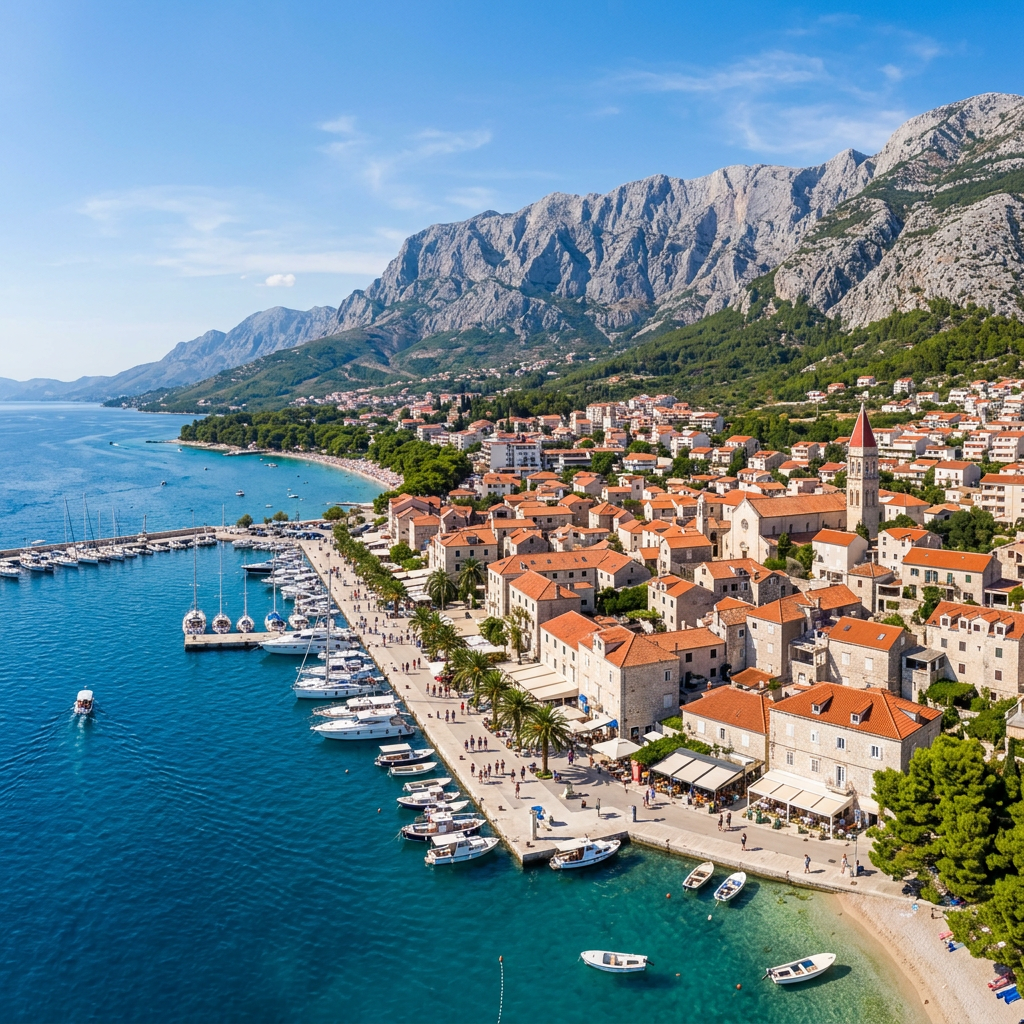
Makarska is the main town of the Makarska Riviera, wedged onto a horseshoe bay with the Biokovo massif rising more or less vertically behind it. The mountain reaches over 1,700 metres about four kilometres from the water, which is why this stretch of coast looks the way it does.
It is the busiest and most urban town on the riviera: a proper harbour, a long pebble beach, restaurants, bars, the main bus station, and a car ferry to Brač. If the surrounding villages feel too quiet, this is where you stay.
This guide covers the beaches, how to actually get up Biokovo (which is stricter than most people expect), where to park, and whether Makarska or one of its neighbours suits you better.
Is Makarska Worth Visiting?
Yes, particularly if you want a beach holiday with a town attached. Makarska is the one place on this coast where you can walk to a supermarket, a pharmacy, a bus station and a nightclub from the beach.
It suits you if:
- you want somewhere to walk to in the evening, not just a beach
- you are visiting Biokovo, since this is the natural base
- you are travelling without a car and need bus and ferry connections
- you want Brač reachable directly rather than via Split
- you want nightlife without Hvar prices
The caveat: Makarska’s own beach is busy, loud and lined with bars, and the town is more built-up than anywhere else on the riviera. If you want the postcard version of this coast — pine shade, white pebble, quiet — Brela is half an hour north and has the better beaches by some margin.
How Long Do You Need in Makarska?
A day
The Riva, the beach and the walk out onto the Sveti Petar peninsula. Fine as a stop on a coastal drive, though it does not show you why people come back.
Three to four days
The right amount. One full day for Biokovo, one for the beaches either side of town, one for Brač or a boat trip, and evenings on the waterfront.
A week or more
Works as a base for central Dalmatia. Split, Omiš, Brela, the Biokovo trails and the islands are all reachable, and the town has enough infrastructure to sustain a longer stay.
Best Things to Do in Makarska
The Riva and Kačić Square
The harbour front curves around the bay, palm-lined and busy from early evening onwards. Behind it, Kačić Square is the town’s centre, with the parish church of St Mark and the market close by.
This is the part of Makarska that makes it a town rather than a resort, and it costs nothing.

Walk the Sveti Petar peninsula
The wooded headland closing the western side of the bay, with a lighthouse at the tip, shaded paths, and swimming off the rocks. It takes about twenty minutes to walk out and back, it is free, and it is where locals go in the heat.
Best at sunset, looking back at the town with the mountain behind it.
The Franciscan monastery and its shell collection
The monastery above the harbour holds a malacological collection — one of the more substantial seashell museums in Europe, assembled by the friars over decades. It is a genuinely odd thing to find in a beach town, the entry fee is small, and it takes half an hour.
Worth knowing about on a wet day, or with children who have run out of beach patience.
Take the ferry to Brač
Makarska has a car ferry to Sumartin on the eastern end of Brač, which is unusual — most of the coast south of Split has no direct island link at all. Fast catamarans also call here on routes linking Split, Brač, Korčula, Mljet and Dubrovnik.
That makes Makarska one of the few riviera towns where island days do not start with a drive to Split.
Biokovo Skywalk: How to Actually Visit
The Skywalk is a glass platform cantilevered off the mountainside at over 1,200 metres, looking straight down the cliff to the coast and out to Brač, Hvar and Korčula. It is the single most popular thing to do from Makarska, and it is also the one most people get wrong.
The rules that catch people out:
- Tickets are sold online only, through Biokovo Nature Park’s own website. You cannot pay at the gate.
- Entry is capped at 20 vehicles per full hour, so you book a time slot and it can sell out days ahead in summer.
- The Biokovo road runs 23 kilometres from the entrance, with the Skywalk about 13 kilometres in. Allow 45 to 60 minutes each way.
- Buses are not permitted on the road, and it is unsuitable for motorhomes, large vans or anything towing.
- The road is narrow with hairpins and steep drops. If you are not confident on mountain roads, take an organised transfer from Makarska instead.
- The Skywalk closes over winter, though the park and its trails stay open.
Ticket prices are set by the park and vary by season — recently in the region of €10 in the shoulder months and €15 at the height of summer, with under-7s free and a discount for mountaineering club members. Check the park’s own site for current rates and slots rather than relying on a figure you read anywhere else, this page included.
Note it is a Nature Park rather than a National Park — a different legal category in Croatia, and the reason your national park pass does not apply.
If the Skywalk is booked out, the mountain itself is still the point. There are marked hiking trails from the coast, and Sveti Jure, Croatia’s second-highest peak, is up there.
Best Beaches in Makarska
The town beach, Donja Luka
Over a kilometre of pebble running west from the centre, pine-backed, with showers, loungers, bars and watersports along its length. Free to walk onto, and busy from mid-morning through the season.
Convenient rather than beautiful. It is the loudest beach on the riviera and it is right in the middle of town, which is either the appeal or the problem.
Nugal
The one worth the effort: a pebble cove under high cliffs south-east of town, reached on a shaded forest path over the Osejava headland in roughly half an hour on foot. There are no facilities and no road access.
It is traditionally a naturist beach and still largely used that way, which is worth knowing before you arrive with the family. Take water and food.
Tučepi
The next town south, with a long pebble beach and a flat coastal promenade running to it from Makarska — walkable in about half an hour, and the easiest way to escape the town beach without transport.
Brela and Baška Voda
North along the D8, twenty to thirty minutes by bus. Punta Rata at Brela is the best beach on this coast, and both towns are quieter than Makarska. If the beach is the reason you came, go north.
All of them are free. You pay for loungers, umbrellas and parking.
Makarska on a Budget
Makarska is mid-range for the coast — cheaper than Hvar, Split or Dubrovnik, dearer than the inland towns. Its advantage is that being a real town means real shops and real bus connections, which is where the savings come from.
Free in Makarska:
- every beach, including the town beach and Nugal
- the Riva, Kačić Square and the old streets
- the Sveti Petar peninsula and the Osejava forest paths
- the coastal promenade to Tučepi
- the marked hiking trails up towards Biokovo from the coast
Biokovo is the big cost. Park entry plus fuel plus, if you are not driving yourself, a transfer. Budget for it as the one paid day of the trip rather than assuming it is a quick detour.
Use the D8 buses. Intercity services along the coast road connect Makarska with Tučepi, Baška Voda, Brela, Omiš and Split frequently in summer, for a fraction of the cost of excursions covering the same ground.
Stay above the centre or in Tučepi. Apartments up the hill behind the town and along the coast either side cost less than the seafront hotels and are still walkable to the beach.
Shop in town, not on the beach. Makarska has full-size supermarkets and a daily market, which most riviera villages do not. This is the place to stock up if you are self-catering anywhere along this coast.
Come in June or September. Rates drop sharply, the Biokovo road is far more pleasant, and the sea is still warm in September. Our Croatia cost guide has the wider daily numbers.
How to Get to Makarska
By bus
Makarska has the main bus station on the riviera, and intercity coaches running the D8 between Split and Dubrovnik stop here frequently. Reckon on about an hour and a quarter from Split and three hours to Dubrovnik.
Unlike the smaller riviera towns, where buses stop up on the main road, Makarska’s station is in the town itself — a genuine advantage with luggage.
By car
The D8 coast road from Split is slower and far more scenic; the A1 motorway to the Zagvozd exit and down through the Sveti Ilija tunnel is quicker from inland. In July and August the coast road through the riviera backs up badly in the late afternoon.
By ferry
The car ferry to Sumartin on Brač runs from the town harbour, and seasonal fast catamarans link Makarska with Split, Brač, Korčula, Mljet and Dubrovnik. Check current timetables with the operators directly, since sailings change between summer and winter.
From the airports
Split Airport is roughly an hour and a half away, Dubrovnik about two and a half. Going via Split city and picking up a coach is much cheaper than a private transfer.
Parking in Makarska
The old town and the Riva are pedestrian, so you park on the approaches or in the lots behind the centre, all charged through the season. Spaces near the beach fill by mid-morning in July and August.
Makarska is compact enough that parking a little further out and walking in costs you five minutes and saves the premium. If you are staying more than a night, accommodation with its own space is worth paying for here.
Where to Stay in Makarska
The centre and the Riva
Best for restaurants, the bus station and evenings out, and you walk everywhere. Noisiest option in peak season.
Donja Luka and the beach strip
Hotels and apartments along the town beach, pine-shaded, a few minutes from the centre. The default family choice.
Above the town
Apartments up the slope towards Biokovo — cheaper, quieter, better views, and usually with parking. You are paying in stairs and a walk back up.
Tučepi, Baška Voda and Brela
The neighbouring towns, all on the bus route, all quieter, and Brela with the better beaches. Worth comparing on price if Makarska itself looks expensive in your dates.
Travelling with children? See our guide to family travel in Croatia.
Best Time to Visit Makarska
May and June. Green, comfortable for Biokovo, cheap, and the sea swimmable from late May. The best months for the mountain.
July and August. Warmest sea and the full nightlife season, and also when Biokovo slots sell out, the beach fills and the coast road jams. Book the Skywalk well ahead.
September. The best compromise. Warm sea, thinner crowds, lower rates, and the mountain pleasant again.
Winter. Quiet, with much of the tourist infrastructure closed and the Skywalk shut, though Makarska stays functioning as a town year-round.
What to Eat in Makarska
Standard Dalmatian on the coast — grilled fish by the kilo, black risotto, octopus salad, shellfish. The more interesting food is inland: the villages behind Biokovo and out towards Imotski do lamb and peka properly, and the Zagora hinterland is where the prosciutto and hard sheep’s cheese come from.
Eat one street back from the Riva. Our guide to food in Croatia covers the regional differences.
Common Mistakes Visitors Make in Makarska
- Driving up to Biokovo without a booked ticket. Tickets are online only and entry is capped at 20 vehicles an hour. You will be turned back.
- Taking a motorhome or large van up the mountain road. It is not suitable, and buses are banned outright.
- Allowing an hour for the Skywalk. It is 45 to 60 minutes of mountain driving each way from the entrance.
- Walking to Nugal with the family unprepared. Half an hour on a forest path, no facilities, and it is a naturist beach.
- Judging the riviera by Makarska’s town beach. Brela and Baška Voda are twenty minutes north and considerably better.
- Driving to Split for the Brač ferry. Makarska has its own crossing to Sumartin.
- Expecting a national park pass to work. Biokovo is a Nature Park, a separate category with its own ticketing.
Makarska vs Brela, Split and Hvar
vs Brela: the decision most people on this riviera face. Brela has much better beaches and quiet evenings; Makarska has the town, the bus station, the ferry and the nightlife. Beach holiday, go Brela; base for the region, stay in Makarska.
vs Split: Split is a city with an airport, Roman ruins and the main ferry port. Makarska is cheaper, has far better beaches and mountains on the doorstep, and is an hour and a quarter away.
vs Hvar: Hvar is the more glamorous and considerably more expensive option. Makarska gives you comparable nightlife at mainland prices, without the ferry.
vs Omiš: Omiš has the river canyon and the adventure sports; Makarska has the mountain and the better beaches. Half an hour apart, so both are doable from either.
Day Trips from Makarska
Brač
Directly by ferry to Sumartin, or by catamaran. Zlatni Rat and the town of Bol are on the far side of the island, so it is a full day rather than a quick hop.
Omiš and the Cetina canyon
Half an hour north for rafting, ziplining and two hilltop fortresses. See our Omiš guide.
Split
An hour and a quarter by coach for Diocletian’s Palace and the old city. Our Split guide covers what to prioritise.
Imotski and the Blue and Red Lakes
Inland behind Biokovo, about an hour, for two enormous collapsed karst sinkholes. Far less visited than the coast and a complete change of landscape.
Hvar and Korčula
Reachable on the seasonal catamaran routes. Hvar is a long day; check the return sailing before you commit.
Makarska FAQs
Is Makarska worth visiting?
Yes, particularly if you want a beach holiday with a proper town attached. Makarska has the riviera’s main bus station, a car ferry to Brač, restaurants and nightlife, with Biokovo Nature Park directly above it. Its own town beach is busy and loud, so if you mainly want quiet beaches, Brela to the north is better.
How do you visit the Biokovo Skywalk?
Tickets are sold online only through Biokovo Nature Park’s website, and entry is capped at 20 vehicles every full hour, so you book a time slot and it sells out in summer. The Biokovo road runs 23 km from the entrance with the Skywalk about 13 km in, taking 45 to 60 minutes each way. Buses are not allowed and the road is unsuitable for motorhomes or large vans.
How much does Biokovo Nature Park cost?
Prices are set by the park and vary by season — recently around €10 in the shoulder months and €15 in high summer, with under-7s free and a discount for mountaineering club members. Check the park’s own website for current rates, and note Biokovo is a Nature Park rather than a National Park, so national park passes do not apply.
Are there good beaches in Makarska?
The town beach at Donja Luka is over a kilometre of pine-backed pebble with full facilities, free to enter but busy and loud. Nugal, a cove under the cliffs reached by a half-hour forest walk, is the most striking but has no facilities and is traditionally naturist. Tučepi is a flat half-hour promenade walk away, and Brela and Baška Voda to the north have the best beaches on the riviera.
How do you get to Makarska?
Intercity buses on the D8 between Split and Dubrovnik stop at Makarska frequently — about an hour and a quarter from Split, three hours from Dubrovnik — and unlike the smaller riviera towns the station is in the town itself. Split Airport is about an hour and a half away. There is also a car ferry to Sumartin on Brač and seasonal catamarans along the coast.
How many days do you need in Makarska?
Three to four days is the sweet spot: one full day for Biokovo, one for the beaches either side of town, one for Brač or a boat trip. A day covers the Riva, the beach and the Sveti Petar peninsula. A week works if you are using it as a base for central Dalmatia.
Is Makarska expensive?
Mid-range — cheaper than Hvar, Split or Dubrovnik and dearer than inland towns. Every beach is free, as are the Sveti Petar peninsula, the Osejava paths and the promenade to Tučepi. Biokovo is the one significant cost. Apartments above the town and in Tučepi are noticeably cheaper than the seafront.
Is Makarska good for nightlife?
Yes, it has the liveliest scene on the Makarska Riviera, with beach bars, waterfront clubs and summer events. It is busier than Brela or Baška Voda and considerably cheaper than Hvar for a comparable night out.
When is the best time to visit Makarska?
May, June and September. Warm enough to swim, much cheaper, and far better for Biokovo, where the mountain road and the Skywalk slots are both easier outside peak season. July and August are the warmest and busiest, and Skywalk tickets sell out days in advance.
Makarska is the working town of a coastline otherwise made of resorts. That is its advantage and its limitation: you get shops, buses, a ferry and somewhere to go at night, and you give up the quiet white-pebble beaches that people picture when they think of this riviera.
Book Biokovo before you arrive, walk north to Brela for the beaches, and take the Sveti Petar path at sunset. More of the Dalmatian coast in our complete Croatia travel guide.
Leave a Reply