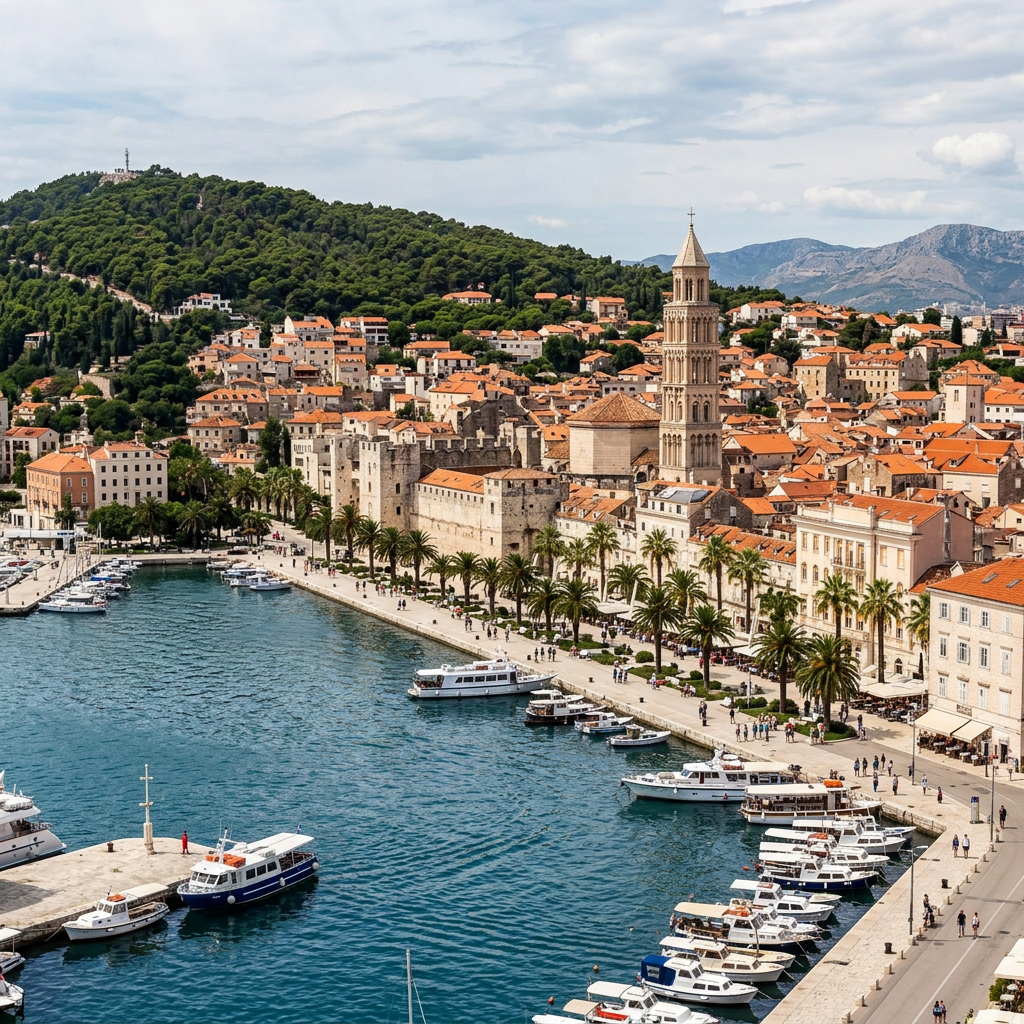
Some cities impress you with landmarks. Others win you over with atmosphere. Split does both effortlessly.
Set along Croatia’s glittering Dalmatian coast, Split is a city where Roman stone walls stand beside buzzing cafés, palm-lined promenades, and ferries bound for idyllic islands. It feels at once historic and alive — a place where two thousand years of history blend seamlessly with contemporary Mediterranean life.
Whether you arrive by sea or train, the city reveals itself in layers: ancient arches, sunlit courtyards, local markets, and the scent of salt drifting in from the harbor.
Split is not just a stop on a Croatian itinerary — it is one of the country’s most dynamic destinations.
Why Split Captures the Essence of Croatia
A Living Roman Masterpiece
At the heart of Split lies the extraordinary Diocletian’s Palace, one of the most remarkable Roman sites in Europe.
What makes it truly unique is that it is not a museum piece frozen in time. It is a living part of the city.
Inside the ancient palace walls, visitors find boutique hotels, cafés, homes, shops, and restaurants woven into the original Roman architecture. Marble lanes echo with footsteps, hidden courtyards bloom with ivy, and every archway hints at another story.
This is history you don’t simply observe — you move through it.
The Pulse of the Riva
If the palace is Split’s soul, the Riva promenade is its heartbeat.
Lined with palm trees, elegant terraces, and sea views, the waterfront is where the city gathers. Morning coffee culture is a ritual here, while evenings bring locals and visitors together for long walks under the fading light.
The Riva perfectly captures Split’s personality: stylish, relaxed, and deeply social.
Must-Experience Highlights in Split
Climb Marjan Hill for the Best View
For a panoramic perspective of the city, Marjan Hill is essential.
A short climb leads to breathtaking views over the terracotta rooftops, harbor, and nearby islands. At sunset, the Adriatic glows in shades of amber and silver, turning the entire city into a cinematic landscape.
It’s one of the most rewarding experiences in Split.
Explore the Old Town Streets
Beyond the major landmarks, Split’s charm lies in its narrow streets and spontaneous discoveries.
Stone alleyways open into tiny squares, local bakeries scent the air with fresh pastries, and hidden wine bars invite you to slow down.
This is a city best explored without hurry.
Gateway to Island Adventures
One of Split’s greatest strengths is its location.
The city serves as the perfect base for day trips to some of Croatia’s most famous islands, including Hvar, Brač, and Vis. For a quieter alternative to all three, Šolta sits just off the coast and sees a fraction of the visitors.
Island hopping from Split adds another dimension to the experience, combining urban culture with coastal escape.
Getting to Split and Getting Around
- The harbour is the whole transport system. The ferry terminal, the main bus station and the train station sit together on the waterfront, a few minutes’ walk from Diocletian’s Palace. Arriving by boat, coach or train puts you in the old town on foot.
- Suburban buses leave from somewhere else. The lines serving nearby towns — Trogir and the airport on Promet Split line 37, Omiš on line 60 — mostly depart from the Sukoišan hub rather than the harbour station, about a kilometre and a half away. Turning up at the wrong one is the most common mistake visitors make here.
- The airport is closer to Trogir than to Split. Line 37 runs Split–Airport–Trogir from around four in the morning until just after midnight, so a first or last night in Trogir is often easier than one in the city.
- The fortress inland is a half-day, not a day trip. Klis is about 15 kilometres from the city, and the Split Tourist Board lists city bus line 34 as the connection, so it works without a car. Three to five hours covers the fortress and lunch.
- For Hvar, take the catamaran, not the car ferry. The catamaran reaches Hvar Town in about an hour. The car ferry takes roughly two hours and docks at Stari Grad, some 20 km away on the far side of the island.
- Do not bring a car into the city. The old town is pedestrian, and parking is charged and full by mid-morning through the season. If you are hiring, collect it on the day you leave rather than on arrival.
- Staying one town out cuts the cost. Split is the priciest base in central Dalmatia. Omiš and Trogir are both cheaper to sleep in and both connected by buses that run late enough to spend the evening in the city and still get back.
The Flavors of Dalmatia
Split’s culinary scene reflects the richness of the Dalmatian coast.
Fresh seafood, grilled octopus, black risotto, local cheeses, olive oil, and regional wines define the dining experience.
Traditional konobas (taverns) sit alongside contemporary waterfront restaurants, offering everything from rustic Croatian classics to elevated fine dining.
Meals here are as much about atmosphere as flavor.
Best Time to Visit
The best months to visit Split are May through September.
June and September are particularly ideal, offering warm weather, vibrant city life, and more comfortable crowd levels than the peak of summer.
Final Thoughts: Croatia’s Coastal Capital of Culture

Split offers the best of Croatia in one destination: Roman heritage, Mediterranean lifestyle, culinary excellence, and effortless access to island adventures.
It is a city of contrasts that somehow fit together perfectly — ancient yet youthful, relaxed yet energetic, historic yet modern.
For travelers seeking the true spirit of the Adriatic, Split is impossible to overlook.
You may also like Dubrovnik or Zadar
Is Split worth visiting?
Yes, Split is one of Croatia’s most popular coastal cities, offering a unique mix of ancient Roman history, beach life, and vibrant modern culture.
What is Split known for?
Split is best known for Diocletian’s Palace, a UNESCO World Heritage Site that forms the heart of the old town, as well as its lively waterfront promenade called the Riva.
How many days do you need in Split?
Most visitors spend 2 to 4 days in Split to explore the old town, nearby beaches, and take day trips to islands like Hvar and Brač.
When is the best time to visit Split?
The best time to visit Split is from May to September, when the weather is warm and ideal for swimming, sightseeing, and island hopping.
What are the must-see attractions in Split?
Top attractions include Diocletian’s Palace, the Riva promenade, Marjan Hill, Bacvice Beach, and the Cathedral of St. Domnius.
Planning beyond Split? Browse our Croatia travel guide for the rest of Dalmatia and the country.
Leave a Reply