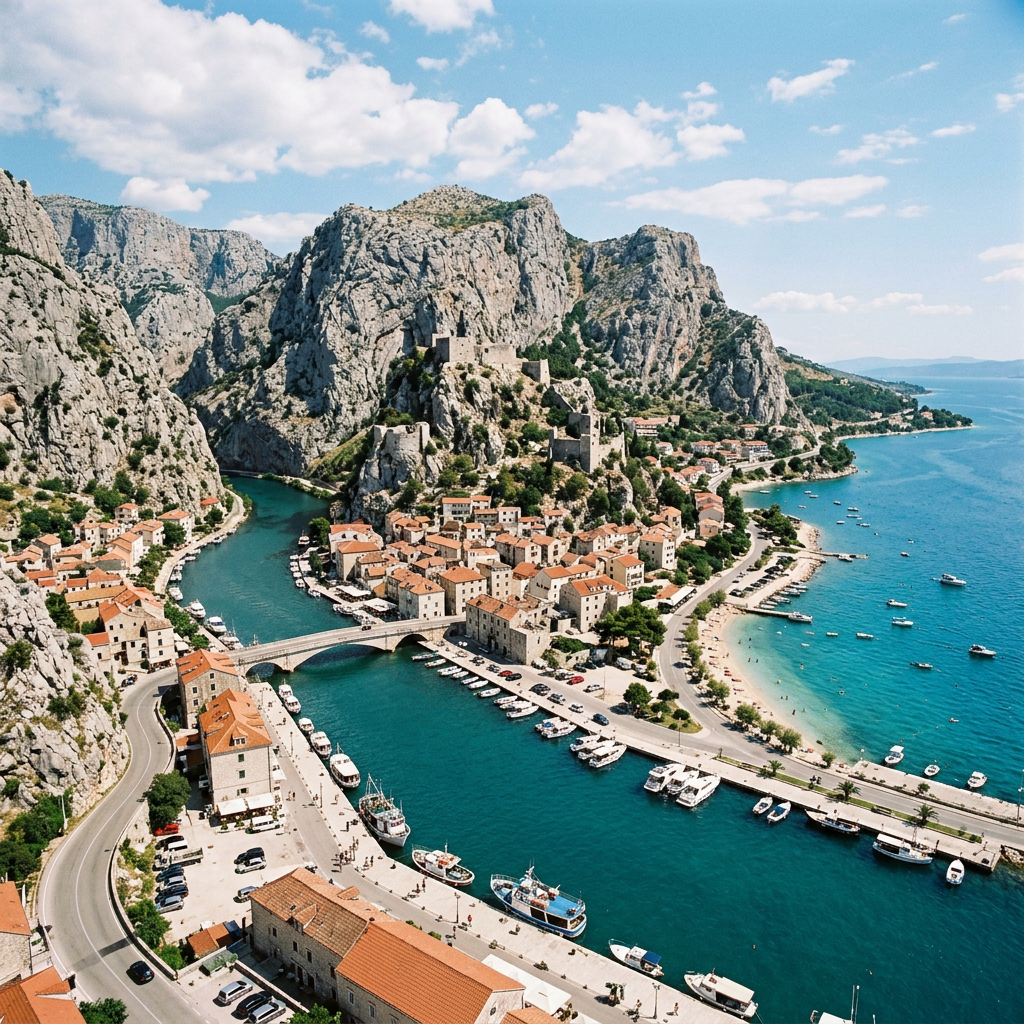
Tucked between towering cliffs and the sparkling Adriatic Sea, Omiš is one of Croatia’s most underrated coastal destinations. While travelers flock to Split and Dubrovnik, this small Dalmatian town offers something completely different — pirate history, dramatic mountains, hidden beaches, river adventures and a much more authentic Croatian atmosphere.
Located just 25 kilometres south of Split, Omiš sits at the mouth of the Cetina River, where emerald-green waters carve through steep limestone canyons before meeting the sea. It’s one of the few places in Croatia where you can go from relaxing on the beach to white-water rafting in less than ten minutes.
This guide covers what to do in Omiš, which beaches are worth your time, what the fortresses cost, how to get here from Split without a car, where to park, and how to keep the whole trip cheap.
Is Omiš Worth Visiting?
Yes, and for a more specific reason than most Dalmatian towns can offer. Unlike many Croatian coastal towns that focus mainly on beaches and nightlife, Omiš combines nature, adventure and history in one compact place you can walk across in fifteen minutes.
What it has that its neighbours do not:
- a river canyon opening directly into the sea at the edge of town
- one of the few genuinely sandy town beaches on the Dalmatian coast
- rafting, ziplining and canyon boat trips within minutes of the centre
- two medieval fortresses, one a short climb and one a proper hike
- a real pirate history rather than a Roman or Venetian one
- lower prices than Split, thirty-five minutes up the road
The caveat: Omiš is a working town, not a resort. The coastal road runs straight through it, so the centre is busier and noisier than the setting suggests, and the best of the scenery needs either a steep hike or a paid activity to reach. If you want somewhere purely restful, Brela down the coast is the quieter choice.
How Long Do You Need in Omiš?
One day
Enough to walk the Old Town, climb to Mirabela for the view, and spend the afternoon on the beach. This is the realistic shape of a day trip from Split.
Two to three days
The sweet spot. Adds one adventure activity — rafting, the zipline or a canyon boat trip — plus the Fortica hike in the cool of the morning and time on the quieter beaches outside town.
Four to five days
Worth it if you are using Omiš as a base rather than a stop, with day trips to Split, Makarska, Brač or the Biokovo Skywalk. Accommodation here is cheaper than Split, so a longer stay costs less than the equivalent in the city.
Best Things to Do in Omiš
Raft the Cetina River
Rafting is the number one activity in Omiš. The Cetina flows through a spectacular canyon filled with waterfalls, crystal-clear water and dramatic cliffs, and most tours are beginner-friendly and suitable for families.
Expect small rapids, swimming stops, cliff jumping and long calm sections between them. Even if you have never rafted before, the Cetina’s rapids are gentle enough for first-timers while still delivering a proper canyon adventure.
Book an early morning departure in summer. The canyon heats up badly by midday, and the morning trips are the ones that fill first.
Hike to Fortica (Starigrad) Fortress
Fortica, also called Starigrad, sits 262 metres above the town and is the harder of Omiš’s two fortresses to reach. It went up in the 15th century as a refuge and strongpoint during the wars with the Ottomans, several centuries after the pirates had gone.
The climb takes roughly 45 to 60 minutes. There are two trails: the river-side route is steeper but spends most of its length in shade, while the sea-side route is easier going and almost entirely exposed. Entry is €3.50, cash only, and children under 10 go free.
From the top you get Omiš Old Town, the Adriatic, the mouth of the Cetina canyon and Brač island in a single sweep. It is the best viewpoint on this stretch of coast.
- wear proper shoes — the rock is loose in places
- carry more water than you think you need; there is nothing at the top
- avoid the middle of the day in July and August
- do not start the climb late in the evening
Climb Mirabela Fortress
Mirabela, known locally as Peovica, is the smaller 13th-century fortress standing directly above the Old Town, and it is the one with the pirate history. Its stairs start beside the main church on the central square, and the climb takes only a few minutes.
Entry is €5 during the main season. You get much the same panorama over the town, the river mouth and Brač that Fortica offers, for a fraction of the effort. If you only have a few hours in Omiš, or you are here with small children or in serious heat, do Mirabela and skip the long hike.
Explore Omiš Old Town
Omiš may be small, but its old town is packed with character: narrow stone alleys, traditional Dalmatian restaurants, small churches, local bakeries and historic stone houses, all squeezed between the cliffs and the river. It feels far less touristy than Split or Dubrovnik, and walking it costs nothing.

The Omiš pirates
During the Middle Ages, Omiš was home to feared pirates who controlled this section of the Adriatic. Protected by the cliffs and by the river at their back, they used fast shallow ships to raid merchant vessels and then retreated into the Cetina gorge where larger ships could not follow.
Today it is part of the town’s identity: pirate symbols, the fortresses themselves, and pirate-themed events through the summer. It is a genuinely distinctive angle compared to most Croatian coastal towns, which tend to lean on Roman or Venetian history instead.
Zipline above the Cetina canyon
The Cetina Canyon zipline runs a series of cables and platforms high above the river, with high-speed crossings and guides at each stage. It is one of the more memorable ways to see the canyon, and it is popular enough in summer that booking ahead matters. Not one for anyone uneasy with heights.
Take a Cetina River boat tour
If rafting sounds too intense, a boat trip covers the same canyon at a gentler pace, travelling inland between cliffs and forest with stops at hidden swimming spots. Many tours pull in at Radmanove Mlinice, the riverside park and restaurant upstream, and it is the most relaxing thing to do in Omiš.
Best Beaches in Omiš
Most of the Dalmatian coast is pebble or bare rock, which makes the sand around Omiš genuinely unusual.
Velika Plaža
The main town beach and the most family-friendly, with shallow water and cliffs rising almost directly behind the sand — a combination that is rare on this part of the coast. You will find beach bars, cafés, sunbed and paddleboard hire and jet skis. It is free to walk onto; only the loungers and the watersports cost anything.
Brzet
A quieter pebble beach west of the centre with very clear water, a short walk from town and usually calmer than Velika Plaža in peak season.
Nemira
Just outside town to the south, with a calmer atmosphere and fewer crowds. Facilities are limited, so bring what you need.
Duće
Stretching north towards Split, Duće has the longest sandy beaches in the area and far more room than the town beach. It is also where a lot of the cheaper apartment accommodation sits, which makes it a good base if you are driving.
Omiš on a Budget
Omiš is cheaper than Split and much cheaper than Dubrovnik, but it is an adventure town, and the activities are where the money disappears. The town itself costs very little.
Free in Omiš:
- the Old Town, its alleys, squares and churches
- Velika Plaža and every other beach in the area
- swimming in the Cetina at the designated spots
- the riverside walk upstream from the bridge into the mouth of the canyon
- the trails up towards Fortica, if you stop at the viewpoints below the gate
Cheap in Omiš: Fortica at €3.50 and Mirabela at €5 are the two paid sights, and either one buys you the view that most people come for. The bus from Split costs a fraction of an organised excursion to the same place.
Pick one adventure, not three. Rafting, ziplining, canyon boat trips, jet skis and canyoning are all sold hard along the waterfront, and doing all of them turns a cheap town into an expensive one very quickly. One activity plus the free canyon walk gives you most of the experience.
Where the rest of the money goes is parking, sunbeds and waterfront restaurants. All three are avoidable: there are supermarkets in town well away from the beach, the sand is free if you bring a towel, and eating one street back from the water costs noticeably less.
Use Omiš as a cheaper base than Split. Apartments here and in Duće undercut equivalent places in Split, and line 60 puts the city thirty-five minutes away for the price of a local bus ticket. If your trip is mostly about Split but your budget is not, this is the trade worth making. Our Croatia cost guide has the wider daily numbers.
Come in May, June or September. Accommodation drops sharply either side of the July and August peak, the rafting season is still running, and the Fortica hike stops being punishing.
How to Get to Omiš
Omiš sits on the coastal road between Split and Makarska, about 25 kilometres south of Split. Rough travel times:
- Split — about 35 minutes
- Split Airport — about 45 minutes
- Makarska — about 45 minutes
- Dubrovnik — about 3 hours
- Plitvice Lakes — about 3.5 hours
From Split by bus
Promet Split runs suburban line 60 between Split and Omiš, taking around 35 minutes and departing roughly every half hour for much of the day. Buses leave from Sukoišan station, about a kilometre from the centre of Split, and Omiš sits in the network’s zone 4.
Tickets are sold on board, at Tisak kiosks, at Promet ticket booths and through the Promet Split app. Check the current timetable on Promet Split’s own site rather than a third-party route planner, since services thin out on Sundays and holidays. This is far and away the cheapest way to make the trip, and it removes the parking problem entirely.
By car
The drive is straightforward along the coastal road, and scenic for most of the way. Allow longer than the map suggests in July and August, when the road through Omiš itself backs up badly, particularly in the late afternoon.
From Split Airport
Roughly 45 minutes by road. Private transfers are easy to arrange and convenient with luggage, but they cost many times the bus fare; going via Split and picking up line 60 is the budget route.
Parking in Omiš
You cannot drive into the Old Town, and parking is the single most common frustration visitors report here. The main car park is on the Split side of the river, before you cross the bridge into town, and it works on a barrier with payment on the way out. It is charged through the season.
Everything in Omiš is within walking distance of everything else, so which car park you choose matters less than when you arrive. In July and August the central spaces fill by mid-morning, and the overflow options involve a long walk back along a busy road. Arrive early, or come by bus and avoid the question.
Where to Stay in Omiš
Old Town
Best for restaurants, walkability and atmosphere. You will not need the car once you have parked it, but rooms on the main road can be noisy.
Near Velika Plaža
Best for families and anyone who wants to walk to the sand in the morning without moving the car. Still only minutes from the Old Town on foot.
Duće
Best for quiet stays, long sandy beaches and apartments with sea views, and generally the cheapest of the three. You will want a car, or patience with the bus.
Travelling with children? Our guide to family travel in Croatia covers what to look for when booking.
Best Time to Visit Omiš
Summer (June to August)
Best for swimming, rafting, boat tours and the evening atmosphere along the waterfront. It is also the hottest, busiest and most expensive stretch, and the worst time to attempt the Fortica hike. July and August are the peak.
Shoulder season (May and September)
Arguably the best time to come. Warm weather, fewer crowds, lower prices, easier parking and comfortable hiking temperatures, with the rafting season still running. September holds the warmer sea of the two.
Winter
Very quiet, and a genuine local atmosphere, but this is an outdoor-activity town out of season. Many of the tour operators and some restaurants close.
What to Eat in Omiš
Dalmatian cooking here focuses on fresh seafood, olive oil and grilled meat. Worth ordering:
- black risotto
- grilled squid
- peka, meat or octopus slow-cooked under a bell
- fresh Adriatic fish, usually sold by the kilo
- soparnik, the Poljica chard pie from the villages just inland
- local olive oil and Dalmatian wine
Soparnik is the one to seek out here: it comes from the Poljica region directly behind Omiš and carries protected status, so this is its home ground rather than a generic Dalmatian dish. Our guide to food in Croatia covers the regional differences.
Common Mistakes Visitors Make in Omiš
- Confusing the two fortresses. Mirabela is the short climb from the square; Fortica is the 45-minute hike high above. Book your legs accordingly.
- Hiking Fortica at midday in August. The sea-side trail has no shade at all, and there is nothing to drink at the top.
- Arriving by car at eleven in the morning in peak season. The central car parks are full and the road through town is at a standstill.
- Turning up at the fortress gate with only a card. Fortica takes cash.
- Booking a paid excursion from Split without checking line 60. The public bus makes the same journey for a fraction of the price.
- Booking three adventure activities. They are the whole cost of a trip here; one is usually plenty.
- Treating Omiš as a half-hour photo stop. The canyon, the fortresses and the beach are the point, and none of them are quick.
Best Day Trips from Omiš
Split
Croatia’s second city is 35 minutes away on the bus: Diocletian’s Palace, the Riva promenade, Marjan Hill and the old town. Our Split guide covers what to prioritise. Trogir and the fortress at Klis both sit just beyond it if you want a longer day.
Makarska
About 45 minutes south, known for its beaches and the wall of the Biokovo range behind the town. See our Makarska guide.
Brela
Roughly half an hour down the same road, and the quieter, prettier stretch of the Makarska Riviera. Punta Rata is the beach people come for. Our Brela guide has the detail.
Brač Island
Reachable by ferry for Zlatni Rat, the town of Bol, olive groves and quiet coves. A full day out rather than a quick hop.
Biokovo Skywalk
A glass viewpoint high on Mount Biokovo, about an hour’s drive. The mountain road is narrow and slow, so allow more time than the distance suggests.
Omiš FAQs
Is Omiš worth visiting?
Yes. Omiš is one of Croatia’s most underrated coastal towns, combining a rare sandy town beach, the Cetina River canyon, two medieval fortresses and a genuine pirate history, all about 25 kilometres from Split. It is also noticeably cheaper than Split itself.
How do you get from Split to Omiš?
Omiš is about 25 kilometres south of Split, roughly 35 minutes away. Promet Split suburban bus line 60 runs the route from Sukoišan station about every half hour for much of the day, with Omiš in zone 4. Tickets are sold on board, at Tisak kiosks, at Promet booths and through the Promet Split app. Driving takes a similar time outside peak traffic.
What is Omiš known for?
Rafting and ziplining in the Cetina River canyon, its medieval pirate history, two hilltop fortresses, and one of the few genuinely sandy town beaches on the Dalmatian coast.
Are there sandy beaches in Omiš?
Yes. Velika Plaža in town and the longer beaches at Duće to the north are among the rare sandy stretches on this part of the Dalmatian coast, where most of the shoreline is pebble or rock.
How much do the Omiš fortresses cost to enter?
Fortica, also called Starigrad, charges €3.50 in cash, with children under 10 free, and takes 45 to 60 minutes to hike from town. Mirabela, the smaller fortress directly above the Old Town, charges €5 during the main season and is only a few minutes’ climb from the main church. Opening hours vary by season, so check locally.
Is Omiš good for families?
Yes. Velika Plaža is sandy and shallow, the Old Town is small and easy to walk, many Cetina rafting trips take children, and the short climb to Mirabela suits most ages. The long Fortica hike is the one thing to think twice about with small children.
Is Omiš expensive?
Omiš is cheaper than Split and much cheaper than Dubrovnik. The Old Town, the beaches and the riverside walk cost nothing, and the fortresses are a few euros each. The expensive part is the adventure activities, so choose one rather than booking several.
How many days do you need in Omiš?
One day covers the Old Town, Mirabela and the beach. Two to three days lets you add rafting or the zipline plus the Fortica hike. Four or five makes sense if you are using Omiš as a cheaper base for day trips to Split, Makarska or Brač.
When is the best time to visit Omiš?
May, June and September. The sea is warm enough to swim, prices and crowds are lower than in July and August, parking is easier, and the Fortica hike is far more comfortable without peak summer heat.
Omiš packs an unusual amount into a small space: a river canyon meeting the sea, two fortresses on the cliffs above, sand where the rest of the coast has pebble, and a pirate history that is genuinely its own rather than borrowed from Rome or Venice. Most of the town costs nothing, and the bus from Split makes it one of the cheapest days out in Dalmatia.
Give it more than the half hour most people driving the coast road allow. Continue planning your trip with our Croatia travel guide, covering the rest of Dalmatia and beyond.
Leave a Reply