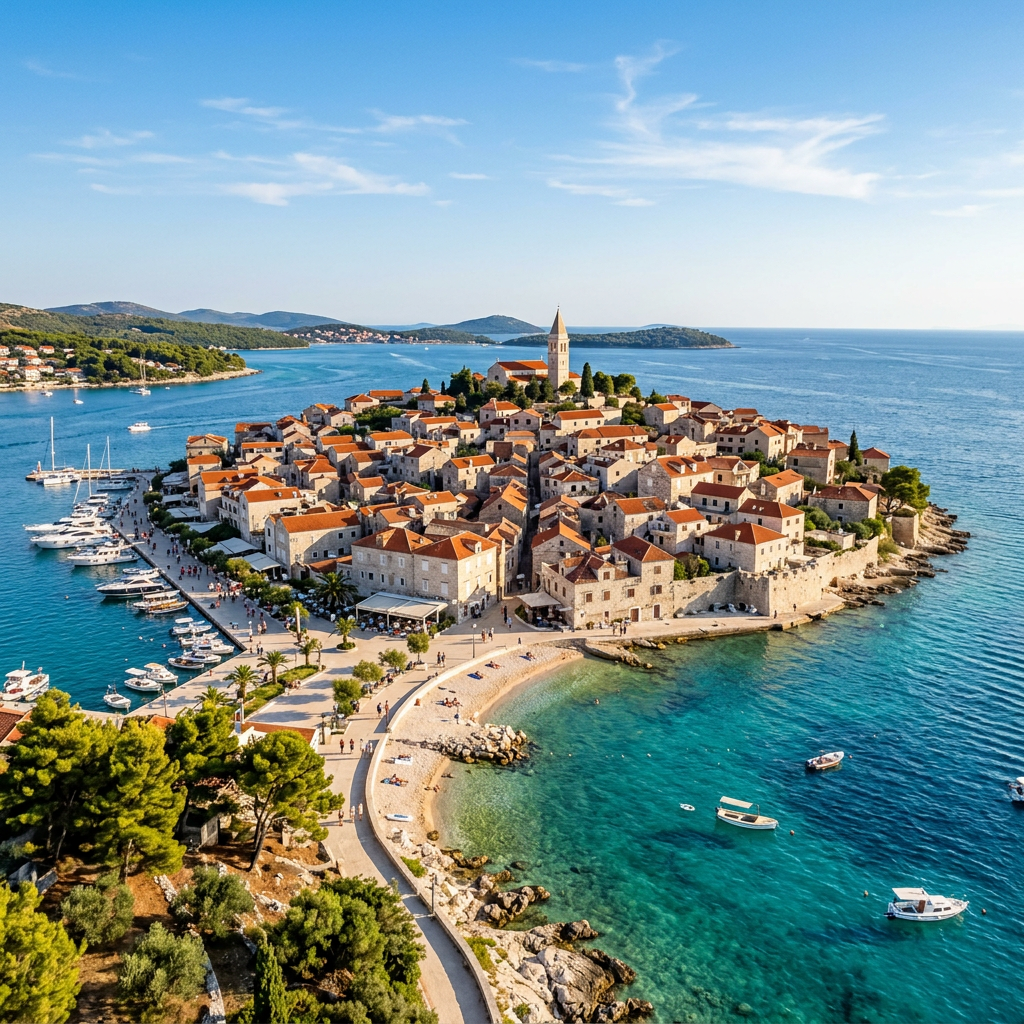
Primošten is a dense cluster of stone houses on a rocky islet, joined to the mainland by a narrow causeway, sitting roughly halfway between Šibenik and Split. It is one of the most photographed silhouettes on the Dalmatian coast, and it is small — you can walk the whole old town in twenty minutes.
The part most guides skip is what is behind it. The hills inland hold the Bucavac vineyards, dry-stone terraces built by hand over centuries to grow Babić, a red grape found almost nowhere else. That landscape is as distinctive as the peninsula, and almost nobody who stops for a photograph goes to see it.
This guide covers how long to give it, which of the Raduča beaches suits you, where to park, how to get here without a car, and whether Primošten is a better base than Šibenik or Trogir.
Is Primošten Worth Visiting?
Yes, though it depends what you want from it. As a stop on a coastal drive it is one of the best on this stretch. As a base for a week it works only if a quiet beach town is what you are after.
What it has:
- an intact old town on an islet, free to walk and traffic-free
- two good pebble beaches within ten minutes of the centre
- a genuinely unusual wine landscape immediately inland
- Krka National Park, Šibenik and Trogir all within an easy drive
- lower prices than Trogir or Split for the same central Dalmatia access
The caveat: Primošten is genuinely small. There is no museum, no major monument and not much to do on a wet day. The old town is beautiful but it is residential, so it empties in the evening outside high season. And parking in July and August is the thing visitors complain about most.
How Long Do You Need in Primošten?
A few hours
Enough for the old town, the climb to the church at the top and a swim at Mala Raduča. This is what a day trip from Šibenik, Trogir or Split realistically looks like, and it works.
Two days
The better option. Day one the peninsula, the promenade and the beaches; day two the Bucavac vineyards, the Loreto viewpoint and a proper dinner with Babić. This is the balance most people should aim for.
Three days or more
Only if you are using Primošten as a base rather than a destination. Krka, Šibenik, Trogir and Rogoznica are all day trips from here, and the accommodation is cheaper than staying in any of them.
Best Things to Do in Primošten
Walk the old town peninsula
The old town occupies what was an island until the causeway was built, and the street plan still reflects that: narrow lanes spiralling up towards the church at the summit, stone houses pressed against each other, and the sea appearing at the end of almost every alley.
It takes twenty minutes to cover and costs nothing. Go up first and work down, and go early or late — the middle of the day is when the tour coaches stop.

Climb to St George’s Church
The parish church of St George crowns the highest point of the peninsula, and the terrace around it is the reason to climb. You get the whole town below you, the Raduča bays either side, and the islands scattered offshore.
The walk up through the lanes is short but steep and the surface is polished stone, so it is slippery in the wet. The view costs nothing.
See the Bucavac vineyards
This is the thing that makes Primošten more than a pretty peninsula. On the slopes inland, generations of growers cleared the karst by hand and stacked the stone into a lattice of dry walls, each enclosing a pocket of soil just big enough for vines. Seen from above it looks like a net thrown over the hillside.
The grape is Babić, grown almost exclusively in the Šibenik area, producing a firm, mineral red that is one of Dalmatia’s most distinctive wines. The vineyards are protected on Croatia’s register of cultural heritage and sit on UNESCO’s tentative list — a candidate for World Heritage status rather than an inscribed site, a distinction plenty of guides get wrong.
Several producers run tastings. You will want a car, or a taxi, to get out there.
The Our Lady of Loreto viewpoint
On the hill above the town, this is where the classic photograph of Primošten is taken from — the peninsula laid out below with the sea on both sides. Best in the late afternoon, when the light is behind you rather than in your lens.
Walk the waterfront promenade
The path wraps the peninsula and continues north around the Raduča headland, linking the harbour, both main beaches and the wilder coves beyond. It is flat, free and the best way to move between beaches without touching the car. Evening, when the fishing boats come in, is the time to do it.
Best Beaches in Primošten
These are pebble beaches in sheltered bays, not sand, and they sit close enough together that you can try all three in a day on foot.
Mala Raduča
The closer of the two to the old town, and the easy default if you are staying in the centre or visiting for a few hours. Pebble, calm, clear, with fewer facilities than its bigger neighbour — though you can walk to those in a few minutes.
Velika Raduča
The main beach, about 300 metres north of the town centre on the coastal path, roughly a ten-minute walk. Longer, pine-backed, with showers, bars, loungers for hire and watersports, and the Hotel Zora alongside it — which is the landmark local signage and satnavs use.
The pines matter: this is one of the better-shaded beaches on the Šibenik Riviera, which counts for a lot in August. There is parking near the entrance at a daily rate.
Dagna
Further north again, about fifteen minutes’ walk from the old town, and noticeably wilder — a rougher, less organised cove with few facilities. Walking out from the town centre, the sequence Mala Raduča to Velika Raduča to Dagna takes you from organised to empty in under half an hour.
All three are free to walk onto. You pay only for loungers, umbrellas and parking.
Primošten on a Budget
Primošten’s real budget argument is positional: it gives you central Dalmatia at lower nightly rates than Trogir, Split or Šibenik, and everything worth seeing in the town itself is free.
Free in Primošten:
- the old town, its lanes and the climb to the church terrace
- all three beaches, and the coastal path linking them
- the Our Lady of Loreto viewpoint
- the harbour and the evening promenade
- driving or walking out to look at the Bucavac vineyard terraces
Use it as a base, not a day trip. If your trip centres on Krka, Šibenik and Trogir, staying in Primošten and driving out costs less per night than staying in any of them, and you get a beach when you come back.
Parking is the avoidable cost. The old town is closed to non-resident traffic, so everyone parks in the lots outside and rates climb in peak season. Booking accommodation with its own space removes the charge for the whole stay, and it is worth asking before you book rather than after.
Walk between beaches. Mala Raduča, Velika Raduča and Dagna are all on the same footpath. Moving the car costs you a second parking fee for a ten-minute walk.
Buy the wine at the producer. A bottle of Babić bought at a winery inland costs a fraction of what the same bottle costs on a waterfront terrace, and the tasting is the better experience anyway.
Come in May, June or September. The sea is swimmable, the parking problem largely disappears and accommodation drops sharply against the July and August peak. Our Croatia cost guide has the wider daily numbers.
How to Get to Primošten
Primošten sits directly on the D8 coastal road between Šibenik and Split, which makes it unusually easy to reach for a town this size.
By bus
Intercity buses running the coast road stop at Primošten, connecting it with Šibenik in roughly 25 to 30 minutes and Split in around 50. Trogir and Rogoznica are on the same route.
Services are frequent in summer and thin out sharply outside it, and they are run by several different operators rather than one, so check current times before you rely on them for a day trip. The bus stop is a short walk from both the old town and Velika Raduča.
By car
Either straight down the D8, which is slower and far more scenic, or the A1 motorway leaving at the Šibenik or Vrpolje exit and dropping to the coast. Roughly 25 minutes from Šibenik, 50 from Split.
From Split Airport
About 45 minutes by road. Transfers are easy to arrange but cost many times the bus fare; going via Trogir or Split and picking up a coast-road bus is the cheaper route if you are travelling light.
Parking in Primošten
The old town peninsula is closed to non-resident traffic, so you park on the mainland side and walk across the causeway. Public lots sit just before the old town entrance, and there is separate parking near the Velika Raduča beach entrance charged at a daily rate.
Rates vary by season and by lot and go up considerably in July and August, so check locally rather than relying on a figure you read in advance. What is consistent is that spaces fill from mid-morning in peak season.
Two things help. Arrive early, particularly on beach days. And if you are staying overnight, ask the accommodation about parking before booking — in the old town especially, you may be walking some distance with luggage.
Where to Stay in Primošten
The old town
Apartments and rooms inside the stone lanes. Atmospheric, and you walk everywhere. The trade-offs are stairs, no vehicle access and a luggage carry from wherever you park.
Near Velika Raduča
Hotels and apartments by the main beach, ten minutes from the centre on the coastal path. The easiest choice with children, and the most convenient if the beach is the point.
The mainland side and inland
Apartments behind the causeway and up the slope. Cheapest of the three, usually with parking included, and still walkable to everything. This is where the value is.
Travelling with children? See our guide to family travel in Croatia.
Best Time to Visit Primošten
May and June. Comfortable for walking the old town and the vineyards, the sea swimmable from late May, prices low and parking straightforward.
July and August. The warmest sea and the liveliest atmosphere, and also when the coaches arrive, the lots fill and prices peak. Plan around mornings.
September and early October. The best window overall. Warm sea, quieter streets, easier parking, and the vineyards at their most interesting with the harvest on.
Winter. Very quiet, and much of the accommodation and many restaurants close. The old town is still worth a walk if you are passing.
What to Eat and Drink in Primošten
Standard Dalmatian cooking done well: grilled Adriatic fish sold by the kilo, octopus or veal under the peka bell, black risotto, shellfish and local olive oil.
The thing to order here that you cannot easily order elsewhere is Babić. It is grown on the terraces you can see from the road inland, it is firm and mineral rather than soft, and it goes with the grilled meat far better than with the fish. Our guide to food in Croatia covers the regional differences.
Common Mistakes Visitors Make in Primošten
- Stopping for twenty minutes and photographing it from the road. The old town, the church terrace and a swim take a couple of hours and are the actual visit.
- Never going inland. The Bucavac vineyards are the most distinctive thing here and most visitors never see them.
- Trying to drive onto the peninsula. It is closed to non-residents; park on the mainland side.
- Arriving at the beach car parks mid-morning in August. They fill, and the alternatives involve a walk.
- Relying on buses out of season. Frequency drops sharply and several operators run the route.
- Expecting a resort. This is a small residential town that happens to be beautiful, not a place with a lot going on.
Primošten vs Šibenik, Trogir and Rogoznica
All four sit within about an hour of each other, and they do different jobs.
vs Šibenik: Šibenik is a real city with a UNESCO cathedral, fortresses and museums, and it is the base if you want history and things to do in the evening. Primošten has the better beaches and costs less. Many people should see both — they are half an hour apart.
vs Trogir: Trogir has the stronger old town, also on an island, also UNESCO-listed, and it is closer to Split and the airport. Primošten is quieter, cheaper and has better swimming. Trogir for the architecture, Primošten for the beach.
vs Rogoznica: the closest comparison, twenty minutes down the coast. Rogoznica is quieter still and built around its marina and the Dragon’s Eye lake. Primošten has more life and the more striking setting.
Day Trips from Primošten
Krka National Park
The closest of the big national parks, with its waterfalls and the walkways at Skradinski buk. Under an hour by road. Go early — it is one of the busiest sites in Croatia in summer, and entry is timed and capped in peak months, so check before setting off.
Šibenik
Half an hour north for the cathedral, the fortresses above the old town and the Krka river mouth. See our Šibenik guide.
Trogir and Split
Trogir is about forty minutes and makes an easy half day; Split is roughly fifty minutes and needs a full one.
Rogoznica
Twenty minutes south, for the marina, the quieter bays and the Dragon’s Eye saltwater lake. Our Rogoznica guide has the detail.
Primošten FAQs
Is Primošten worth visiting?
Yes. The old town on its islet is one of the most striking settings on the Dalmatian coast, it is free to walk, and the Raduča beaches are within ten minutes on foot. It is small, though — there is no museum or major monument, so it suits a few hours or a two-day stay rather than a long one.
What is Primošten known for?
Its old town on a former island joined to the mainland by a causeway, the church of St George at its summit, the Raduča pebble beaches, and the dry-stone Bucavac vineyards inland that produce Babić red wine.
How many days do you need in Primošten?
A few hours cover the old town, the church terrace and a swim. Two days is the better balance, adding the Bucavac vineyards and the Loreto viewpoint. Three or more only makes sense if you are using Primošten as a base for Krka, Šibenik and Trogir.
What are the best beaches in Primošten?
Mala Raduča is closest to the old town and the easy default. Velika Raduča, about 300 metres north on the coastal path, is the main beach with pine shade, showers, bars and watersports. Dagna, fifteen minutes’ walk further, is wilder with few facilities. All are pebble and all are free.
Where do you park in Primošten?
The old town peninsula is closed to non-resident traffic, so you park on the mainland side and walk across the causeway. Public lots sit just before the old town entrance, with separate parking near the Velika Raduča beach entrance at a daily rate. Rates rise in July and August and spaces fill from mid-morning, so arrive early or book accommodation with parking included.
How do you get to Primošten without a car?
Intercity buses on the D8 coast road stop at Primošten, connecting it with Šibenik in about 25 to 30 minutes and Split in around 50, with Trogir and Rogoznica on the same route. Services are frequent in summer and much thinner outside it, and several operators run the route, so check current times.
Is Primošten good for families?
Yes. The Raduča bays are calm and sheltered, Velika Raduča has facilities and pine shade, the old town is traffic-free, and everything is close enough to walk. The beaches are pebble rather than sand, so water shoes are worth packing.
Is Primošten a good base for central Dalmatia?
It is a strong budget base. Krka National Park, Šibenik, Trogir, Rogoznica and Split are all day trips from here, and nightly rates are lower than staying in Trogir, Split or Šibenik themselves. The trade-off is that Primošten itself is quiet, with limited evening options.
When is the best time to visit Primošten?
May, June, September and early October. Warm enough to swim, far easier for parking, and much cheaper than the July and August peak. September also catches the grape harvest inland.
Primošten is worth more than the photograph everyone takes from the coast road. The old town repays an hour on foot, the Raduča bays are among the better beaches on this stretch, and the stone-walled vineyards inland are the kind of landscape you will not see anywhere else in Croatia.
Give it two days, park on the mainland side, and go inland at least once. See more of central Dalmatia in our complete Croatia travel guide.
Leave a Reply